L'eau vs d'eau

Great question! Let's break it down clearly and simply:

🧊 "L'eau" vs "d'eau" in French:


1. "L’eau" = “the water”

Used when you're talking about specific or general water, with a definite article ("the").

Examples:

  • Je bois l’eau. = I drink the water.
  • L’eau est froide. = The water is cold.
  • L’eau de la rivière = The river water.

2. "D’eau" = “(some) water” / "of water"

Used after quantities, negations, or expressions requiring “de”.

Examples:

  • Je bois un verre d’eau. = I drink a glass of water.
  • Il n’y a pas d’eau. = There is no water.
  • Beaucoup d’eau = A lot of water.

🧠 Summary:

Expression Meaning in English When to use
l’eau the water When referring to specific water or water in general
d’eau some/of water After quantities, negations, or "de" phrases

If you want, I can give you a quiz to test yourself—or explain more cases like “de l’eau” vs “d’eau” vs “l’eau” 😊

Turn Website Visitors Into Leads

I am Girish, and I started creating websites using HTML, JavaScript, etc., joining different ad networks and displaying their ads with the content of my websites in the year 1999, when I was in university for my graduation and post-graduation. My first website was dedicated to displaying job vacancies. I bought a domain name and a USA-based server for hosting the website.

I remember perfectly that the website performed well and was able to attract many visitors. With the growth in the number of visitors, I started earning online a little bit through the Google AdSense platform’s delivered ads. Slowly, due to growing traffic loads on my website, the American-based server company started informing me to upgrade the server or the website would be frequently offline, meaning no one could find my website. And it started to happen.

I also became tired of copying the content of other websites and pasting it onto my own. I wished to do something original. However, with time, I learned that the main reason for getting high traffic on my first website was because of its service-provider nature. Everyone searches for job vacancies—did in the past, does in the present, and will do in the future.

One day, the American-based server company suddenly closed my website, citing high visitor numbers. Also, the Google AdSense platform canceled my account, stating high numbers of clicks on the displayed ads. Sometimes, I was afraid of these high numbers of visitors and clicks, which could get my website shut down—and at last, it happened.

Learning from the Experience

During this period, I joined and worked with many ad networks to display their ads, but I found the best was AdSense due to its simplicity for ad code integration with website HTML, as well as monitoring performance reports and monthly earnings transfers to the bank.

Moreover, with this experience, I learned how to create websites, what HTML is, how to work with JavaScript, CSS, etc. I do not have an education in information technology, so all of this was new to me. But my engagement in solving problems on a daily basis helped me understand these IT tools and how to apply them for converting ideas into earnings.

At that time, I was paying $10 for a domain name and $30 for website hosting each year. As time passed, I started thinking about what to do next with my wish to continue online endeavors. From my first experience, I made a strategy to make a new website but display my own original content and look for ways to avoid the total cost of $40 per year.

Reducing Website Hosting Costs

I started to investigate and found that it is unavoidable to pay $10 for a domain name, but I could avoid the $30 hosting fee. I applied this strategy and still do. I have several domain names registered but hosted on Google Blogspot servers.

Currently, I pay the cost of my many domain names, but not for website hosting. The total cost of domain names is still a good amount of money. With this strategy, I developed many websites: www.Latestfoto.com, www.immigrationopportunity.com, www.freetraveltours.com, etc., and I write and post original content on all of them with ads provided by different ad networks under partnerships and affiliate agreements.

You can visit my websites to look at those ads and identify which ad network has been used to deliver each one. So far, two goals have been fulfilled: reducing website creation-related costs and publishing original content.

The New Challenge: Getting Visitors

Now, I have a new challenge: how to bring visitors to my websites. By comparing visitor data from Blogspot statistics, Google Analytics, and AdSense reports, I understood once again that service-related content is essential. Otherwise, no one will visit my original content, even though it is well-written and informative.

In today’s advanced lifestyle, people want solutions to their problems and spend time on content that serves this purpose. For example, people engage more in entertainment-related content because they want to escape their daily problems—family, social, professional, or health-related—if only for a few minutes.

It became my focus to write original content that includes something helpful for visitors. This is a point on which I am still working, thinking, and applying different strategies.

Applying SEO: A Turning Point

Whenever I searched online for how to increase the number of visitors, the common recommendation was to apply SEO (Search Engine Optimization). I decided to try SEO, but I had no idea what to do. With time and experience, I learned that SEO involves organizing your content with headings (h1, h2, h3, etc.), bullet points, etc., using HTML.

In Blogspot, h1 is built-in for the title, so I use h2, h3, h4, etc., for my content. Then, I find and incorporate keywords—trending keywords, long-tail keywords, specific keywords, low-demand and high-demand keywords—into my original content. I also write these keywords as labels for my web pages.

Next, I write a 145–150 word meta description that includes keywords. I create SEO URLs by including keywords in the permanent URL of the webpage. So, it's not just about writing and posting original content—SEO requires doing all this every time.

And I see the impact: thanks to SEO, my websites now receive more visitors.

Next Problem: No Earnings Despite Traffic

But now, I face another challenge: there are no earnings. What should I do? This is where my next journey begins: Turn website visitors into leads.

If I don’t know where to display ads on my websites, they will fail to generate revenue, and I’ll continue paying domain name costs from my pocket. Now, the domain registrar has increased the yearly price to $17 per domain.

Failed Strategies and Lessons

I’ve read different recommendations online, but in my case, most didn’t work.

Email marketing: This didn’t work for me, even though I have more than 10k emails. I made newsletters and sent them out, but Gmail can easily detect bulk emails—even if sent to a few recipients—and mark them as spam. I gave up on this option because, like many others, I ignore most marketing emails myself.

Guest posting: I’ve never done it. I don’t know where to post guest articles. Big websites often require minimum word counts, original content, verified sources, and still reserve the right to reject submissions because they receive too many.

Sharing: This strategy also does not work for me. One common recommendation I read on other websites is to share the weblinks of my articles on social media platforms like Facebook and Twitter. (YouTube and Instagram don’t allow direct sharing of links in the same way.) The idea is to share links through Facebook chats, Instagram chats, or other social media messaging apps, create groups on WhatsApp with social contacts registered in mobile phone including friends and family, make dedicated pages on Facebook and Twitter, invite my contacts to subscribe, and then share links regularly.

However, this approach did not work for me. People, including friends and family, might click on the links a few times initially, but eventually, they stop clicking and lose interest in reading the articles. 

Doing Comments: Commenting on other websites and including weblinks to my own websites didn’t work for me, even though I tried many times. There was no real growth in visitor numbers. I understand why — I’ve also received notifications to moderate comments when someone writes on a webpage and includes a weblink. Many of those comments get flagged as SPAM by Blogspot’s servers. I usually don’t take action (accept or reject) when I see a weblink in the comment. I’m sure other website owners do the same with my comments containing my weblinks, so no visitors get redirected to my sites. So, this method just doesn’t work.

AdManager: I have more than 10,000 webpages across my websites and many agreements with different ad networks to display ads. These ads come in several formats — click-based, call-to-action based, impression-based, and more. I write articles and insert ad codes continuously, but after months or years, sometimes an ad network informs me that the agreement has been terminated, and I must remove all their ad codes since they won’t pay for any revenue generated after termination.

Some networks stop delivering ads immediately, but most continue showing their ads on my websites, even after the agreement ends. Removing ad codes from 10,000 webpages manually is nearly impossible. For years, I wanted to create a centralized AdManager to control ads from different networks across my sites. That way, if a network ends an agreement, I could quickly replace their ads with another network’s ads.

Finally, after many days of hard work and research, I succeeded in developing my own AdManager. One more problem solved! 

Bounce Rate: I can easily find the bounce rate of visitors on my websites through Google Analytics. Earlier, I thought this data was not very important. But now I realize it is crucial if I want to turn my websites into leads. The bounce rate tells me how many people visit my websites but leave immediately without spending any time because they don’t find the site interesting at first glance.

Now the question is: how can I collect email addresses, phone numbers, or other contact information that allows me to reach out to these visitors and invite them to return? This is the key to turning visitors into leads.

Conclusion: The Ongoing Mission

Although SEO is working and bringing in traffic, I now need to learn how to turn website visitors into leads. This must be solved to generate earnings, sustain my domains, and grow online.

How to Change url of Pages in Blogspot

How to change url of pages in blogspot because I donot see any option but on post I can see.

On Blogspot (Blogger), you cannot manually change the URL (permalink) of pages — this option is only available for posts.

Why?

  • Blogspot treats pages (like "About", "Contact", etc.) differently from posts.

  • Pages get automatic URLs based on their title, and Blogspot does not provide a manual permalink option for them.


Workarounds to Control or Customize Page URLs

Option 1: Use a post instead of a page

  • Posts let you set a custom permalink.

  • You can create a post and use it like a page (e.g., for an "About Me" or "Terms" page).

  • Then, add that post to your menu or navigation manually.

Option 2: Redirect the page URL using JavaScript or meta tag

If you created a page but want it to point to another custom URL (like a post with a better URL), you can add a redirect:

Step-by-step:

  1. Go to Pages > Edit the page you want to redirect.

  2. Switch to HTML view.

  3. Paste the following code:

<meta http-equiv="refresh" content="0; url=https://your-new-url.com">

Or, using JavaScript:

<script>
  window.location.href = "https://your-new-url.com";
</script>
  1. Save the page.

Now, when someone visits that page, it will immediately redirect to the URL you specify.


Additional Tip:

You can hide the original page from menus if you're just using it to redirect.


Summary:

  • Posts: Can edit the URL (use "Custom Permalink" when publishing).

  • Pages: URL is auto-generated from the title — no manual control.

  • Solution: Use posts as pages, or add redirect code in the page’s HTML.


Cómo Toca Mejor Una Mujer

Historia, intimidad y conexión emocional

Descubrir cómo toca mejor una mujer no es solo una cuestión física, sino también emocional, mental y sensorial. En esta historia real y reflexiva, te llevamos a un recorrido íntimo donde los sentidos, la empatía y el respeto juegan un papel fundamental. Es una lectura para quienes desean entender mejor las claves del placer femenino y la comunicación en pareja.

Un encuentro inesperado

Todo comenzó una tarde tranquila en Madrid. Laura, una fotógrafa de 34 años, viajaba en tren hacia Granada. No esperaba encontrar nada extraordinario, pero entonces conoció a Clara, una terapeuta de arte que hablaba con pasión sobre el cuerpo, el tacto y las emociones.

Durante el viaje, Laura escuchaba con atención. Clara hablaba sobre cómo una mujer puede explorar su cuerpo sin tabúes ni prejuicios, aprendiendo lo que le gusta, lo que la calma y lo que la hace vibrar. “Tocar no es solo poner la mano”, decía, “es saber cuándo detenerse, cuándo avanzar, cuándo escuchar con la piel”.

Exploración sensorial y consciente

La historia de Laura y Clara no solo fue un descubrimiento mutuo, sino también una puerta hacia un nuevo entendimiento. Clara enseñó a Laura que el autoconocimiento sexual femenino empieza por la observación, la respiración y el amor propio.

En una noche bajo las estrellas, en una casa rural en Sierra Nevada, Laura empezó a aplicar lo que Clara le contaba. Tocarse no era con prisa, sino con intención. Explorar no era buscar un fin, sino un camino. Conectar con su cuerpo significaba quitarse los juicios aprendidos, mirar el espejo con amor y tocarse como se acaricia una flor que apenas empieza a abrirse.

Comunicación en pareja: la clave olvidada

Tiempo después, Laura compartió este aprendizaje con su pareja. Descubrieron que la mejor forma en que una mujer toca o es tocada implica palabras, silencios y miradas. Hablar de lo que gusta, sin vergüenza, es tan importante como el acto en sí.

Las parejas que se comunican sobre sus deseos suelen experimentar una vida íntima más plena. Usar frases como “me gusta cuando haces esto”, o “prefiero que vayas más lento” transforma un momento íntimo en una danza compartida. Clara lo decía claro: “El placer femenino florece con la confianza.”

Conexión emocional y deseo auténtico

“¿Cómo toca mejor una mujer?” se preguntaba Laura cada vez que se miraba al espejo. La respuesta no venía de una técnica específica, sino de una actitud. Tocar mejor es estar presente. Es querer entender, no controlar. Es entregarse, no solo estimular.

Laura empezó a escribir un diario íntimo. En él, registraba sensaciones, emociones y fantasías. Descubrió que la conexión emocional con una misma era lo que más influía en la intensidad del placer. Y que cuando se sintió segura, el deseo fluyó como un río sin obstáculos.

La ciencia detrás del placer femenino

Los estudios científicos respaldan muchas de las cosas que Laura aprendió con Clara. Según investigaciones del Journal of Sexual Medicine, la estimulación del clítoris, el consentimiento mutuo y el tiempo dedicado al juego previo son factores clave para una experiencia placentera.

Además, el 85% de las mujeres afirman que la combinación de estimulación física y emocional aumenta significativamente la calidad del placer. No se trata solo de “cómo tocar”, sino también de cómo escuchar, cómo observar, cómo cuidar.

Consejos prácticos para mujeres que quieren tocar mejor

  • Conócete a ti misma. Usa un espejo, explora sin prisa, observa qué zonas te dan más placer.
  • Practica la respiración consciente. Ayuda a relajar y a conectar con el momento presente.
  • Usa tus manos, no como herramientas, sino como puentes. Varía la presión, el ritmo, la temperatura.
  • Habla con tu pareja. La intimidad se construye en equipo, no en silencio.
  • Infórmate. Libros, podcasts y talleres sobre sexualidad femenina pueden abrirte nuevos caminos.

Traspasando el tabú

En muchas culturas, hablar sobre cómo toca mejor una mujer sigue siendo un tabú. Laura lo vivió en su entorno más cercano. Pero al compartir su historia, descubrió que muchas otras mujeres querían saber más, explorar, reconectar con su cuerpo.

Hoy, Laura da charlas sobre sexualidad femenina consciente. Enseña que el placer es poder, y que tocar con amor, sin miedo, es un acto de empoderamiento. “La mejor forma de tocar”, dice, “es aquella que nace del respeto, la presencia y la ternura.”

Por qué este tema interesa

El título “cómo toca mejor una mujer” se ha convertido en una búsqueda recurrente en Google, especialmente entre usuarios de habla hispana interesados en mejorar su vida íntima, explorar su cuerpo y fortalecer sus relaciones.

Palabras clave como “sexualidad femenina consciente”, “placer femenino”, “cómo estimular a una mujer”, “autoconocimiento erótico” y “tocarse con amor” son altamente buscadas.

Conclusión

El verdadero arte de tocar

La historia de Laura y Clara nos recuerda que tocar no se aprende en un manual, sino en la experiencia, la escucha y el respeto. “Cómo toca mejor una mujer” es una pregunta que se responde con amor, con tiempo y con autoconocimiento.

Si tú también te has preguntado cómo mejorar la conexión contigo misma o con tu pareja, este es el inicio de un viaje hacia el placer auténtico y la libertad personal. Porque cuando una mujer toca con consciencia, el mundo entero vibra con ella.

Get Your Own AdManager a Centralized Way to Manage Ads

AdManager Part 1: The Origin – Why I Needed a Custom Ads Management System

Managing ads across more than 10,000 Blogspot pages is no joke. I had been juggling various affiliate programs – Amazon, AliExpress, Booking, local retailers – each with different codes, banner formats, and end dates. What’s worse? I had no centralized way to monitor, update, or remove them once a partnership expired. The result? Outdated ads, broken links, and lost revenue.

🤯 The Problems I Faced

  • Scattered ad codes: Embedded manually on every page.
  • No expiry logic: Couldn't deactivate ads when affiliate deals ended.
  • Revenue leakage: Some links were dead or redirected incorrectly.
  • Manual effort: Updating ads meant editing hundreds of HTML pages.

💡 The Breakthrough Moment

One day, I asked myself: What if I could manage all my ad codes in one Google Sheet, and use a bit of Apps Script magic to control what appears on each post?

This was the seed for AdManager – a centralized, Google Sheets-powered ad delivery system that would read post labels and insert the correct ad code dynamically.

🚀 Need a Custom AdManager for Your Blog?

Let me build you a fully functional, easy-to-manage AdManager system that puts you in control of your blog's monetization — no coding needed, scalable, and budget-friendly.

✨ Live Examples:

💌 Ready to boost your blog’s ad performance? Let’s make it happen! Just send me a message — I’ll handle the tech while you focus on your content.

🎯 The Vision

Build a tool where:

  • I control all ads from a single Google Sheet.
  • Each post shows ads based on its labels (e.g., “Fashion” shows a Zalando banner).
  • I can disable any ad instantly by removing it from the Sheet.
  • Tracking and updating affiliate links becomes painless.

🔍 What You’ll Learn in This Series

  1. How to structure the Google Sheet to hold your ad logic.
  2. How to write the Apps Script that powers ad display.
  3. How to auto-inject the script into thousands of Blogspot posts.
  4. How to troubleshoot performance, errors, and tracking.

Ready to take control of your ad revenue? In Part 2, I’ll show you how I structured the Sheet, defined my labels, and created the logic to match ads with Blogspot content. It’s simpler than you think!


Next up: AdManager Part 2 – Structuring the Google Sheet for Success

AdManager Part 2 – Structuring the Google Sheet for Success

Once I knew I wanted centralized control over my ad placements, I had to figure out what kind of data structure would power the system. After testing multiple formats, I came up with a simple, scalable setup using just one tab in Google Sheets: Sheet1.

📊 Sheet Layout

The columns I used:

  • Label – The Blogspot label to match (e.g., "Fashion", "Tech").
  • AdCode – The actual HTML/JavaScript snippet for the ad.
  • Status – Set to "on" or "off" to activate or deactivate the ad.
  • StartDate – Optional: When to start showing the ad.
  • EndDate – Optional: When to stop showing the ad.

🧠 Why This Format Works

  • Simple for humans to manage.
  • Scalable to hundreds of ads.
  • Easy for Apps Script to read and process.

📌 Sample Sheet

Label AdCode Status StartDate EndDate
Fashion <script src="https://fashionads.com/ad1.js"></script> on 2025-01-01 2025-12-31
Tech <a href="https://techaffiliate.com/deal"><img src="https://techaffiliate.com/banner.jpg" /></a> off

⚠️ Pro Tips

  • Use plain text for ad code – no extra formatting in the cell.
  • Keep your label names consistent with Blogspot tags.
  • Use "off" to instantly stop showing an ad on all posts.

In Part 3, I’ll walk you through writing the Apps Script that connects your blog posts to this Sheet and dynamically injects the correct ad code.


Next up: AdManager Part 3 – Writing the Script That Powers It All

AdManager Part 3 – Writing the Script That Powers It All

Now that the Sheet is ready, it's time to connect the logic: Google Apps Script. This part is the brain of the operation—it reads the Sheet, looks at a Blogspot post’s labels, and shows the appropriate ads.

⚙️ Script Goals

  • Read ad data from the AdManager → Sheet1 tab.
  • Compare each row’s Label against the current page’s labels.
  • Filter only active ads (status = “on” and valid date range).
  • Output the matching ad codes.

📜 The Apps Script

Add this code in Extensions → Apps Script:

function doGet(e) {
  const sheet = SpreadsheetApp.openById('YOUR_SHEET_ID').getSheetByName('Sheet1');
  const data = sheet.getDataRange().getValues();
  const query = e.parameter.labels ? e.parameter.labels.split(',') : [];
  const today = new Date();
  
  let output = '';

  for (let i = 1; i < data.length; i++) {
    const [label, adCode, status, start, end] = data[i];

    if (status !== 'on') continue;
    if (start && new Date(start) > today) continue;
    if (end && new Date(end) < today) continue;
    if (!query.includes(label)) continue;

    output += adCode + '\n';
  }

  return ContentService.createTextOutput(output).setMimeType(ContentService.MimeType.TEXT);
}

Make sure to replace 'YOUR_SHEET_ID' with your actual Google Sheet ID.

🌐 Deploy the Script as Web App

  1. Go to Deploy → Test deployments.
  2. Choose type: Web app.
  3. Execute as: Me.
  4. Who has access: Anyone.
  5. Click Deploy, and authorize if needed.
  6. Copy your web app URL – you'll use this in the frontend.

✅ Output Example

Requesting:

https://script.google.com/macros/s/XXXXXXXXX/exec?labels=Fashion,Tech

Returns the ad codes for “Fashion” and “Tech” if they’re active.


Next up: AdManager Part 4 – Injecting the Script into 10,000 Blogspot Pages

AdManager Part 4 – Injecting the Script into 10,000 Blogspot Pages

Now comes the exciting part: delivering the ads to all your Blogspot posts automatically. This step requires inserting a small script into your Blogspot theme or each post’s HTML to load the ad dynamically using your Apps Script Web App.

🎯 Goal

  • Each Blogspot post detects its own labels (tags).
  • The script sends those labels to your Web App.
  • The Web App returns matching ad code(s).
  • The script injects them into a specific location on the page.

📥 Step-by-Step Injection Script

Add this JavaScript snippet into your Blogspot theme or inside each post (in the HTML view):

<script>
  (function() {
    const labels = [...document.querySelectorAll('.post-labels a')].map(el => el.textContent.trim()).join(',');
    const url = 'https://script.google.com/macros/s/YOUR_SCRIPT_ID/exec?labels=' + encodeURIComponent(labels);

    fetch(url)
      .then(response => response.text())
      .then(code => {
        const container = document.getElementById('admanager-slot');
        if (container) container.innerHTML = code;
      });
  })();
</script>

🪄 HTML Placeholder for Ads

Where you want the ads to show up, insert this:

<div id="admanager-slot"></div>

📌 Tips for Massive Scale

  • Use Blogspot Layout → Theme → Edit HTML to inject the script site-wide.
  • Or use Apps Script + Blogger API to bulk update post HTML (advanced).

✅ Final Result

Every post automatically pulls and displays ads matching its labels. You never have to manually update an ad again.


Next up: AdManager Part 5 – Managing Expired Ads & Troubleshooting

AdManager Part 5 – Managing Expired Ads & Troubleshooting

With 10,000+ pages and multiple affiliate partnerships, it's crucial to ensure ads don’t stay live after they expire. This part explains how to manage ad validity using date filters, and how to fix common issues.

🗓️ Managing Expired Ads

Remember the StartDate and EndDate fields in your Google Sheet? Here’s how the script uses them:

  • Only show ads where Status = on
  • StartDate ≤ today ≤ EndDate (if dates are provided)

This ensures your ads disappear on time. If you leave dates blank, the ad is always eligible—controlled only by the Status field.

🧪 Troubleshooting Common Problems

1. Ads not appearing?

  • Check the label names – must exactly match Blogspot post tags.
  • Ensure the Web App URL is correct in your script.
  • Confirm the ad is set to "on" and within valid date range.

2. Empty HTML returned?

  • Verify that labels= is correctly constructed in the fetch URL.
  • Use Logger.log(query) in the script to debug parameters.

3. Script not running at all?

  • Check for JavaScript errors in the browser console (F12).
  • Ensure Blogspot theme includes the JS snippet and ad placeholder.

🚦 Version Control for Ad Partners

If an affiliate ends the program or changes their code, just remove or update the ad row in your Sheet. No need to touch any post code.

📈 Bonus Tip: Tracking Performance

Add tracking parameters (like UTM codes) to your ad links or use an external redirect script to count clicks per ad ID. You can even extend the Sheet to include a Clicks column updated via Google Analytics or Firebase.


Next up: AdManager Part 6 – Bonus: Future Ideas & Automation Tips

AdManager Part 6 – Bonus: Future Ideas & Automation Tips

With the AdManager system up and running, there’s still more you can do to improve automation, scaling, and ad performance. Here are some advanced ideas and tips to keep growing.

🤖 Auto Deactivation with Google Apps Script Triggers

Create a time-based trigger that runs daily and automatically sets ads to "off" if their EndDate has passed.

function autoDeactivateAds() {
  const sheet = SpreadsheetApp.getActiveSpreadsheet().getSheetByName('Sheet1');
  const data = sheet.getDataRange().getValues();
  const today = new Date();

  for (let i = 1; i < data.length; i++) {
    let end = data[i][4]; // EndDate
    if (end && new Date(end) < today && data[i][2] === 'on') {
      sheet.getRange(i+1, 3).setValue('off'); // Status column
    }
  }
}

Set this function to run with a trigger from Triggers → Add Trigger → Time-driven.

📦 Add Categories or Ad Types

Extend your Sheet with a Type column (e.g., "banner", "sidebar", "in-post"). Then adjust the script to load specific ad types into specific page areas.

🔍 Track Impressions and Clicks

  • Add onAdShown() to count when an ad is injected.
  • Redirect click URLs through a tracker to count conversions.

Use Firebase, Google Analytics, or custom logs stored in another Google Sheet.

🔄 Multiple Ad Slots per Post

Define more than one placeholder, like:

<div id="admanager-top"></div>
<div id="admanager-bottom"></div>

And adjust your Apps Script to return specific ads by position.

🎉 Conclusion

This AdManager system started from a single need—controlling ads without manually editing 10,000+ pages—and evolved into a powerful, flexible tool that can grow as your site and partnerships grow.

Keep optimizing, automating, and building smarter tools. That’s what makes your blog sustainable in the long run. 🚀

Types of Glial Cells in the Retina

 In the retina, glial cells provide structural, metabolic, and homeostatic support for neurons. There are three main types of glial cells in the retina:


🔹 1. Müller Glial Cells

  • Most abundant glial cell in the retina.

  • Span the entire thickness of the retina — from the inner limiting membrane (ILM) to the outer limiting membrane (OLM).

  • Functions:

    • Structural support

    • Regulation of extracellular environment (ions, neurotransmitters)

    • Light conduction (optical fiber-like role)

    • Response to injury (reactive gliosis, GFAP upregulation)

    • Blood-retinal barrier support


🔹 2. Astrocytes

  • Located mainly in the nerve fiber layer (NFL) and around the optic nerve head.

  • Less numerous than Müller cells.

  • Functions:

    • Support for blood vessels (especially at the optic nerve head)

    • Structural and metabolic support

    • Express GFAP in both normal and injured retina

    • Participate in inflammatory responses


🔹 3. Microglia

  • The resident immune cells of the retina.

  • Distributed throughout all layers, especially:

    • Inner plexiform layer (IPL)

    • Outer plexiform layer (OPL)

  • Functions:

    • Immune surveillance

    • Phagocytosis of debris

    • Involved in inflammatory and degenerative retinal diseases

    • Can change morphology in response to stress (from ramified to amoeboid)


🧠 Summary Table:

Glial Cell Type Location in Retina Main Functions GFAP Expression
Müller Cells Spans entire retina Structural, metabolic, response to injury Low (normal), ↑ with injury
Astrocytes Nerve fiber layer Vascular support, structural, inflammatory High (normal and injured)
Microglia Throughout (esp. IPL/OPL) Immune defense, debris clearing No GFAP


Young Adults in Europe are Putting Away Smartphones

Why Young Adults in Europe Are Putting Away Smartphones A New Digital Awakening

In the summer of 2024, something quietly radical happened on the streets of Amsterdam, Barcelona, Berlin, and beyond. Emma, a 24-year-old UX designer in Munich, slipped her phone into a drawer. Not for an hour. Not for a detox weekend. She left it there for a month. Her story isn’t unique anymore. All over Europe, a growing number of young adults are putting away smartphones — not out of obligation, but as a conscious decision to reclaim their lives.

The Start of a Movement

This isn’t just another digital detox trend. It’s a generational shift in digital habits. In cities across Europe, young professionals, students, and creatives are choosing to disconnect from the constant ping of notifications. They're swapping screens for real-world presence, eye contact, and serendipitous conversations. This behavioral shift is driving discussions in universities, coworking spaces, cafés, and even therapy sessions.

Why Are They Putting Away Smartphones?

The reasons are layered, but most fall into a few key themes:

  • Digital Overload: The pandemic normalized remote everything — work, education, therapy, even dating. As a result, people found themselves online almost 24/7. Young Europeans started experiencing screen fatigue, anxiety, and burnout.
  • Loss of Authentic Connection: Platforms like Instagram and TikTok, once sources of inspiration, began to feel performative and draining. “I was curating a life instead of living it,” Emma recalls.
  • Privacy Concerns: Surveillance capitalism, AI tracking, and targeted ads stirred unease. Many grew uncomfortable with how their data was being mined.
  • Desire for Mental Clarity: Constant notifications disrupt focus and increase anxiety. Putting away the phone is an act of mental hygiene for many.

What Are the Alternatives?

The move away from smartphones hasn’t left a void. In fact, it’s sparked a revival of slower, intentional technologies and analog experiences. Here are some of the alternatives young adults in Europe are embracing:

1. Dumb Phones and Minimalist Devices

Sales of “dumb phones” — devices with basic call and SMS functions — have surged. Brands like Light Phone, Punkt, and Nokia are seeing increased traction in cities like Paris, Copenhagen, and Vienna. These phones offer essential communication without apps, social media, or internet distractions.

2. Wearables With Boundaries

Smartwatches with limited capabilities are being used to stay accessible (e.g., for calls or health tracking) without getting sucked into apps. Young adults are customizing settings to remove distractions.

3. Analog Entertainment

Books, vinyl records, film cameras, and board games are making a major comeback. Community spaces now host “analog nights,” where no devices are allowed, and people interact over shared activities.

4. Journaling and Handwriting

Many have returned to journaling, using pen and paper as a mindfulness tool. Bullet journals, sketchbooks, and planners are replacing productivity apps. It’s not nostalgia — it’s a shift in values.

5. Real-Life Social Networks

Community events, hobby meetups, and coworking clubs are filling the social gap once occupied by Instagram DMs and Facebook events. Apps like Meetup (ironically still digital) help people connect — then log off.

Where Is Their Engagement At Present?

This generation isn't retreating from technology entirely — they’re redefining how and when they use it. Key trends include:

1. Intentional Internet Use

More users are restricting smartphone use to specific time blocks. They check emails twice a day instead of constantly. They use browser extensions that limit social media and block news doomscrolling.

2. Shift to Desktop Over Mobile

Instead of consuming content on the go, many now prefer engaging with digital media from their laptop — with intention, and often for a shorter duration. It's part of a growing “tech hygiene” practice.

3. Localized Living

Young Europeans are rediscovering their neighborhoods — visiting farmer’s markets, volunteering in community gardens, joining yoga studios. The focus has shifted to offline, local engagement instead of scrolling through global feeds.

4. Focus on Deep Work and Mindfulness

Flow state is the new goal. Many are structuring their days to support deep work — uninterrupted time for creativity, problem-solving, or learning. Digital distractions are seen as the enemy of this new productivity ethos.

>Young Generation is Searching:

  • Why are young adults in Europe quitting smartphones?
  • Digital detox trends in Europe 2025
  • Best dumb phones for digital minimalists
  • Alternatives to smartphones for students and creatives
  • How to unplug in a connected world

The New Cool

Disconnection

In many social circles across Europe, disconnection is becoming a badge of honor. Saying “I’m not on Instagram” or “I don’t carry my phone everywhere anymore” isn’t weird — it’s admired. It signals freedom from digital dependency, and a focus on mental wellness and presence.

In Copenhagen, artist cooperatives are banning phones during creative workshops. In Lisbon, morning walking clubs are thriving because they combine movement, connection, and digital silence. In Zurich, students at ETH have started an offline club — where silence and slow conversation are sacred.

What This Means for the Future

This isn’t about rejecting technology, but about redefining digital engagement on human terms. Young adults across Europe are setting boundaries with screens — not because someone told them to, but because they want to experience the fullness of life again.

“The world feels real again,” Emma says, sipping coffee in a Berlin café where phones are discouraged. “I hear birds now. I see people. I sleep better. I feel better.”

Conclusion 

A European Awakening

The smartphone isn't dead. But its dominance is being questioned in ways we haven’t seen before. For many young Europeans, putting away the smartphone is the beginning of something deeper — a return to self, community, and presence. It’s not a tech retreat; it’s a life reboot.

If you're inspired to try this shift, start small. Turn off notifications. Put your phone away during meals. Buy a notebook. Walk without music. You might just find yourself again.


    Dreaming of Moving Abroad? Here’s How You Can Make It Work

    Dreaming of Moving Abroad

    Many people who dream of moving abroad get stuck in a spiral of questions and “what ifs.” Where would I go? How can I make it work? Will I be accepted? What if it doesn’t work out? These are natural concerns, especially when considering such a big life change. But the truth is, relocating to another country doesn’t have to be overwhelming.

    Today, more Americans than ever are exploring the idea of living overseas. Whether you're chasing a slower pace of life, lower cost of living, or simply a cultural adventure, moving abroad can be the fresh start you’ve been waiting for.

    Why More Americans Are Choosing to Live Abroad

    With the rise of remote work and the gig economy, it's easier than ever to take your career with you. Combine that with affordable international destinations, and suddenly, the idea of starting a new life abroad isn’t just a dream—it’s a viable reality.

    Countries like Portugal, Spain, Mexico, Costa Rica, Thailand, and Vietnam are attracting American expats in record numbers. These nations offer great weather, welcoming communities, and a lower cost of living. In fact, in many of these places, your dollar stretches much further, giving you a higher quality of life for less.

    Overcoming the “What Ifs” of Moving Abroad

    It's normal to feel overwhelmed by uncertainty. Here’s how to tackle the most common questions:

    1. Where Should I Go?

    Start with some research. Think about your priorities: Do you want a beach town, a bustling city, or a quiet village? Are you seeking affordability, job opportunities, or excellent healthcare?

    Top trending destinations for American expats in 2025 include:

    • Portugal – Easy visa options, English-friendly, and great climate.
    • Mexico – Close to the U.S., diverse regions, and affordable healthcare.
    • Thailand – Digital nomad-friendly, low cost of living, rich culture.

    2. How Can I Afford It?

    You don’t need to be rich to move abroad. Many people finance their move through:

    • Remote jobs in tech, marketing, customer support, or teaching English.
    • Freelancing or online businesses (like blogging, consulting, or YouTube).
    • Retirement savings or social security for older expats.

    Creating multiple income streams online is a smart way to prepare. Monetizing your travel blog or YouTube channel with Google AdSense is a great start—just ensure your content is original, follows policy, and adds real value to readers.

    3. Will I Be Accepted?

    Most expats find that respect and curiosity go a long way. Learn the basics of the local language, embrace cultural differences, and be open to new customs. Locals often appreciate visitors who make an effort.

    4. What If It Doesn’t Work Out?

    It’s okay to try and change your mind. Many expats adjust within a few months, but some decide to return home. That’s not failure—it’s part of the journey. Having a plan B and saving a “return fund” can give you peace of mind.

    Practical Steps to Start Your Life Abroad

    1. Choose the Right Visa

    Visa requirements vary, so check official government sites. Many countries now offer digital nomad visas or residency permits for retirees, students, and entrepreneurs. For example:

    • Portugal’s D7 Visa for remote workers and retirees.
    • Mexico’s Temporary Resident Visa for long-term stays.
    • Thailand’s Long-Term Residence Visa for professionals and retirees.

    2. Sort Out Finances and Healthcare

    Set up an international bank account or a service like Wise for easy currency transfers. Make sure you understand tax obligations in both the U.S. and your new home.

    Also, invest in international health insurance—some countries require proof before granting a visa.

    3. Downsize and Digitize

    Sell or donate items you don’t need. Scan important documents, and back them up online. The less baggage (literally and emotionally), the easier the move will be.

    4. Learn the Language

    Apps like Duolingo, Babbel, and iTalki make language learning accessible. Even just basic phrases can help you navigate markets, taxis, and conversations.

    Success Stories 

    Real Americans Living Abroad

    Lisa from California moved to Lisbon after working remotely for a year. “I didn’t know anyone, but I joined Facebook expat groups and found support fast. My rent here is half what I paid in L.A., and the food is incredible.”

    James and Sara from Texas relocated to Mérida, Mexico. “We were worried about safety and healthcare, but those fears disappeared quickly. We live in a beautiful home, and the local clinic is excellent. Plus, we’re learning Spanish together—it’s brought us closer.”

    How to Stay Connected and Make Friends Abroad

    Being far from home doesn’t mean you have to feel alone. Here are tips to build a social life:

    • Join Facebook groups and expat forums before your move.
    • Use Meetup to attend local events or language exchanges.
    • Volunteer or take classes to meet locals and other expats.

    Make Your Dream of Living Abroad a Reality

    Whether you want to retire on the beach, explore new cultures, or give your family a new experience, moving overseas is more possible than you think. With thoughtful planning, respect for your new home, and a little courage, you can build a life you love abroad.

    And if you're thinking of starting a blog or sharing your journey, remember that original, helpful content can also become a source of income. Add AdSense-approved ads, and your story could inspire others while helping fund your adventure.

    Trending Searches Related to Moving Abroad

    • Best countries for American expats 2025
    • How to move abroad with no money
    • Remote jobs for living overseas
    • How to apply for a digital nomad visa
    • Affordable countries to live and work

    Final Thoughts

    Moving abroad may seem like a leap, but for many people, it's a leap into a better, more fulfilling life. Don’t let the “what ifs” hold you back. Take the first step—research, plan, and start dreaming big. The world is full of possibilities.

    Still wondering how to begin? Subscribe to travel newsletters, connect with expats, and explore your options. One day, you might just find yourself sipping coffee in a sunlit plaza, realizing your dream has come true.

    Disclaimer: This article is for informational purposes only. Please consult immigration experts and financial advisors before making relocation decisions.

    La historia de las berenjenas rellenas, una receta que salvó mi verano

    Berenjenas rellenas al horno la receta saludable que transformó mi verano

    El verano pasado, mientras el calor se colaba por las rendijas de mi vieja cocina en Valencia, me encontré frente a un dilema culinario: ¿cómo preparar algo ligero, saludable y delicioso sin pasar horas cocinando? Como si el universo escuchara mi desesperación, mi vecina Lola apareció con una sonrisa, una cesta de verduras frescas de su huerto y una sugerencia: berenjenas rellenas al horno.

    “Son fáciles, sanas y están de muerte,” me dijo con ese acento andaluz que hacía que todo sonara más sabroso. Nunca me había interesado especialmente por las berenjenas. En mi cabeza eran solo una verdura más que terminaba olvidada en el cajón del frigorífico. Pero esa tarde todo cambió. Y con ello, también cambió mi manera de entender la comida casera.

    Un viaje a través de la cocina tradicional

    Decidí aceptar el reto y prepararlas. Mientras las lavaba, cortaba y vaciaba con cuidado, empecé a pensar en lo poco que conocía sobre esta hortaliza morada. Lola, siempre dispuesta a compartir sabiduría, me contó que las berenjenas al horno rellenas tienen raíces antiguas en la cocina mediterránea. En Grecia las rellenan con carne y bechamel; en Marruecos con especias y frutos secos; en Italia, con mozzarella y tomate.

    Pero aquella receta española que me compartió era diferente. Simple, aromática y perfecta para los que, como yo, buscan recetas fáciles y saludables sin renunciar al sabor.

    Los ingredientes que cambian el día

    La receta original llevaba cebolla, ajo, tomate natural, pimiento rojo y la propia carne de la berenjena. Todo ello rehogado en aceite de oliva virgen extra hasta que los aromas inundaban la cocina. Para los que comen carne, se le añade carne picada de pollo o ternera, pero también me ofreció una versión vegetariana con lentejas cocidas que me dejó maravillado.

    En ese momento descubrí que las recetas vegetarianas no son sinónimo de aburridas. Al contrario, la textura de las lentejas, mezclada con los vegetales y las especias, creaba una fusión deliciosa que no extrañaba nada la proteína animal. Rematar con queso rallado y gratinar en el horno fue el toque final.

    La magia del horno y los sabores que reconfortan

    Tras 20 minutos en el horno, el resultado fue un plato dorado, jugoso y con ese aroma que te abraza desde el primer bocado. Entendí por qué esta receta era un clásico entre quienes aman la comida reconfortante sin complicaciones. Además, es perfecta para hacer en cantidad y guardar en la nevera o congelador.

    Aquella noche, sentado frente al ventilador, saboreando mis berenjenas rellenas al horno, sentí que había descubierto un pequeño tesoro culinario. Compartí la foto en redes sociales y, para mi sorpresa, fue mi publicación con más “me gusta” en meses. La gente pedía la receta, trucos y versiones sin gluten o veganas.

    Del plato al blog: una nueva pasión

    Inspirado por el éxito, abrí mi blog de cocina donde compartí esa receta con fotos paso a paso. Le añadí consejos sobre cómo adaptar las berenjenas rellenas para niños, cómo usar ingredientes económicos sin perder calidad y cómo combinarla con una ensalada fresca o arroz integral.

    El artículo se posicionó rápidamente gracias a las búsquedas como “cómo hacer berenjenas rellenas”, “recetas al horno fáciles” y “comida sana para toda la familia”. Sin darme cuenta, aquella receta cambió no solo mis cenas, sino también mi rutina. Comencé a explorar otras recetas con berenjenas, como la musaka, la caponata o las berenjenas rebozadas sin freír.

    Secretos y variantes para todos los gustos

    Hoy en día, preparo berenjenas rellenas de mil formas: con quinoa, con atún y maíz, con champiñones y tofu o incluso con sobras del pisto. Me gusta aprovechar lo que tengo en la despensa. Esa versatilidad convierte esta receta en una opción ideal para quienes buscan cocina de aprovechamiento y evitan el desperdicio de alimentos.

    También descubrí un truco valioso: si las berenjenas son amargas, basta con espolvorearles sal tras vaciarlas y dejarlas reposar 30 minutos. Luego se enjuagan y quedan listas, sin ese sabor fuerte que a veces las hace poco atractivas.

    Una receta con corazón

    Más allá del sabor, las berenjenas rellenas me enseñaron algo importante: a veces, los platos más sencillos en apariencia son los que esconden historias profundas, aprendizajes y conexiones. Lola me regaló mucho más que una receta; me dio una excusa para parar, cocinar y compartir.

    Desde entonces, las berenjenas se han convertido en un símbolo en mi cocina. Cuando las veo en el mercado, pienso en ese primer verano y en cómo algo tan simple puede inspirar cambios positivos. Ahora las incluyo en mis menús semanales, las recomiendo a amigos, y hasta mis sobrinos las devoran sin protestar.

    Consejos rápidos para tus berenjenas rellenas perfectas

    • Escoge berenjenas medianas: son más fáciles de manejar y se hornean de forma uniforme.
    • Pre-cocina la pulpa: saltearla antes de rellenar mejora el sabor.
    • Usa queso bajo en grasa: ideal para una receta ligera sin perder textura.
    • Añade especias: el comino, orégano, tomillo o curry pueden transformar el plato.

    Una receta que une generaciones

    Hace poco, mi madre —que siempre ha sido muy clásica con sus guisos— probó mis berenjenas vegetarianas rellenas y pidió repetir. Mi padre, que nunca fue fan de las verduras, me sorprendió diciendo: “No sabía que esto podía estar tan bueno”. Cocinar se convirtió en una actividad familiar, algo que hacíamos juntos los domingos.

    Es increíble cómo una receta tan sencilla puede convertirse en un ritual que une generaciones. Las comidas saludables no solo nutren el cuerpo, sino también el alma, cuando se comparten en buena compañía.

    ¿Te animas a prepararlas tú también?

    Si estás buscando una opción sabrosa, económica y muy adaptable, no lo dudes: las berenjenas rellenas al horno son para ti. No importa si llevas años en la cocina o estás comenzando. Esta receta te acompañará, te salvará más de una cena y, si tienes suerte, también te inspirará a contar tu propia historia culinaria.

    Porque a veces, lo que comienza con una simple receta termina siendo el punto de partida para algo más grande. En mi caso, fue el comienzo de una vida más consciente, sabrosa y creativa. ¿Y tú? ¿Qué historia vas a cocinar hoy?

    Inquiokupas

    The term "inquiokupas" is a colloquial blend of two Spanish words:

    • "Inquilinos" (tenants)
    • "Okupas" (squatters or illegal occupants)

    "Inquiokupas" refers to tenants who legally enter a rental property but later stop paying rent and refuse to leave, effectively behaving like squatters while having originally entered through a legal rental agreement.

    This term is mostly used in Spain and reflects concerns among landlords about the difficulty of evicting non-paying tenants due to lengthy legal processes. It's not a formal legal term but rather a popular expression in media and social discussions.

    Nuclear Bomb Can Be Stopped After Launch or Drop

    Nuclear Bomb Can Be Stopped After Launch or Drop

    Stopping a nuclear bomb after it has been launched or dropped is extremely difficult, and no current technology guarantees full protection against a nuclear detonation. However, there are some modern technologies and strategies that aim to intercept, neutralize, or reduce the impact of a nuclear attack. Here’s a breakdown of what is theoretically and practically possible today:

    🔒 Prevention and Deterrence (Most Effective)

    1. Mutually Assured Destruction (MAD)

      • This Cold War-era doctrine is still relevant. It means if one country launches a nuke, the other will respond with equal or greater force, ensuring mutual destruction.
      • It discourages the initial launch.
    2. Treaties and Diplomacy

      • Nuclear Non-Proliferation Treaty (NPT)
      • Strategic Arms Reduction Treaty (START)
      • Diplomacy and inspections by the IAEA (International Atomic Energy Agency)

    🛡️ Missile Defense Systems

    These systems attempt to detect, track, and intercept nuclear missiles before impact:

    1. THAAD (Terminal High Altitude Area Defense)

      • Intercepts short- to medium-range ballistic missiles.
      • Deployed in South Korea, UAE, and by the U.S.
    2. Aegis Ballistic Missile Defense (BMD)

      • Ship-based system capable of intercepting ballistic missiles mid-flight.
      • Uses Standard Missile (SM-3) interceptors.
    3. Ground-based Midcourse Defense (GMD)

      • Designed to destroy intercontinental ballistic missiles (ICBMs) in space before re-entry.
      • Currently deployed in the U.S.
    4. Iron Dome / David's Sling / Arrow (Israel)

      • Highly effective at intercepting short-range threats (Iron Dome) and ballistic missiles (Arrow).

    🔴 Limitations: These systems can only defend specific regions, may be overwhelmed by multiple warheads, and are less effective against hypersonic weapons or stealth delivery methods.

    💥 Can a Dropped Bomb Be Stopped Mid-Air?

    If a bomb is dropped from a plane, as opposed to a missile, interception becomes even harder:

    1. Air Defense Systems (e.g., Patriot Missiles, S-400, or S-500)

      • Can shoot down aircraft before the bomb is released.
      • Once the bomb is falling freely, almost no system can intercept it before detonation due to:
        • Speed
        • Low altitude
        • Short reaction time
    2. Electronic Warfare?

      • In theory, one could attempt to jam or disable guidance systems if the bomb is smart-guided.
      • But atomic bombs don’t rely on electronics to detonate once triggered — they are built to go off no matter what.

    🧪 Advanced Concepts (Not Yet Real-World Ready)

    1. Directed Energy Weapons (Lasers)

      • Research continues into using high-powered lasers to shoot down missiles mid-flight.
      • Not yet practical for intercepting falling nuclear bombs.
    2. Hypersonic Interceptors or Space-based Weapons

      • Still theoretical or in early testing.

    ☢️ Can We Neutralize a Nuclear Bomb After Launch?

    No current technology can "disarm" a nuclear bomb after launch. Once the fission or fusion chain reaction is triggered, it is impossible to stop the explosion. Therefore:

    Best defense = early detection + missile interception + hardened infrastructure + diplomacy.

    🏗️ Civil Protection Measures

    If all else fails, countries prepare through:

    • Underground bunkers
    • Radiation shelters
    • Civil defense drills
    • Early warning systems (e.g., satellites, radar)

    ✅ Final Answer

    No, there is currently no foolproof technology to stop the effect of a nuclear bomb after it has been dropped or launched. The best hope lies in:

    • Early interception (before detonation),
    • Preventing launch (via diplomacy or deterrence),
    • And civil defense preparation.

    High Alert: A Fighter Pilot’s Brave Encounter at the Border

    It was 04:57 a.m., and the sky above the airbase was cloaked in twilight. Squadron Leader Arjun Malik, one of the most experienced fighter pilots in the Indian Air Force, was sipping his first coffee of the day inside the readiness bunker. The morning silence was shattered by the sudden wail of the emergency siren—a long, blaring note that triggered every nerve in his trained body.

    “Scramble alert! Scramble alert!” echoed the voice over the intercom. In less than a second, Arjun dropped his cup, donned his G-suit, helmet, gloves, and visor, and sprinted out toward the tarmac. The base was a symphony of urgency—ground staff rushed like a well-oiled machine, wheeling fuel lines, checking weapons, and clearing the runway.

    Prepping the Beast

    The Fighter Jet

    There she was—his jet, a sleek Sukhoi Su-30MKI, already powered up by the ground crew. Her twin engines purred like a predator ready to pounce. A crew chief gave Arjun a sharp salute. “All clear, sir. Fully armed with air-to-air missiles and a short-range rocket pod.”

    Arjun climbed up the ladder and slid into the cockpit. The canopy closed above him with a click, sealing him into the control chamber of one of the world’s most advanced military aircraft. He went through the quick launch checklist: avionics—green, fuel levels—optimal, weapons—hot. The jet's HUD (Head-Up Display) lit up with a digital green glow.

    “Tower, this is Eagle-One. Requesting clearance for immediate takeoff,” Arjun radioed in.

    “Eagle-One, you’re clear. Winds at 2 knots east. Good hunting,” replied the controller.

    Into the Sky

    Arjun taxied to the runway. The nose of the Sukhoi pointed straight into the awakening sky. “Ignition,” he whispered, throttling up. The afterburners roared like a dragon, and within seconds, the aircraft surged forward, slicing through the early dawn.

    The ground dropped beneath him as he climbed steeply. Clouds brushed past his canopy as he leveled out at 18,000 feet. The Indian plains were now a canvas below—fields, rivers, and forests blending into a living mosaic.

    As he reached cruising altitude, Arjun exhaled deeply. The cockpit was filled with the soft hum of instruments, the faint buzz of radio chatter, and the whisper of air brushing past the fuselage. The feeling of flying—alone, high above the Earth—was something indescribable, a mix of adrenaline and serenity. The sky was infinite and silent. A reminder of both power and vulnerability.

    Enemy in Sight

    Suddenly, the radar pinged. The unmistakable flash of a bogey—an unidentified aircraft—appeared 45 nautical miles northeast, flying dangerously close to Indian airspace. Arjun's grip tightened. The aircraft’s IFF (Identification Friend or Foe) system confirmed it—an incoming Pakistani JF-17 Thunder.

    “Eagle-One to Control. I have visual confirmation of a hostile JF-17 breaching our airspace. Requesting permission to engage.”

    “Eagle-One, you are weapons-free. Intercept and neutralize,” came the cold, firm reply.

    Arjun turned the nose of his jet toward the bogey. His eyes scanned the horizon until he spotted a glint—a flash of light against the sun. The enemy fighter was visible, zigzagging with evasive maneuvers. The two jets danced across the sky, beginning a high-stakes dogfight.

    Locked On

    Arjun rolled left, climbed high, and then dipped low—a classic “high yo-yo” maneuver. The enemy pilot responded with tight turns, countering with flares to mislead any heat-seeking missiles. But Arjun’s experience showed. He pressed buttons on the flight control panel, loading the AIM-132 short-range missile.

    The HUD locked on: Target Acquired. His thumb hovered over the red launch trigger on his joystick. Inside the jet’s sealed canopy, time slowed. His breathing matched the rhythmic beep of the lock-on signal.

    “Fox Two,” he whispered and pressed the trigger.

    The rocket booster roared as the missile detached and rocketed forward with a fiery tail. Seconds later, an explosion lit up the sky. A cloud of black smoke followed. The hostile aircraft was hit—descending in a burning spiral before disappearing beneath the clouds.

    Flying the Border

    “Enemy down,” Arjun reported. Cheers erupted on the comms. But he wasn't done yet. His orders were to patrol the border region for another thirty minutes to ensure there were no further threats.

    He flew along the tense Line of Control, eyes scanning every inch of radar and sky. The sun now rose in full glory, painting the clouds gold and crimson. Arjun felt a wave of emotion—relief, pride, and a touch of melancholy. War was never glorious, but defending your land always held a certain sacredness.

    He looked up into the deep blue—a sky so vast, it felt like swimming in silence. From this height, Earth seemed fragile. Below, nations squabbled. Up here, there was only air, light, and silence. He banked his jet gently, savoring the freedom of flight.

    Returning to Base

    After confirming no further threats, Arjun radioed in for return clearance. “Eagle-One returning to base. Mission complete.”

    The descent was smooth. The Sukhoi responded to every touch like an extension of his own body. As he approached the runway, he cut the throttle, deployed flaps, and landed with perfect control. The jet's wheels screeched lightly on the tarmac, slowing to a stop as the parachute deployed behind.

    Ground staff rushed forward. Arjun opened the canopy and climbed down, sweat dripping from his brow. The base commander greeted him with a handshake. “Brilliant job, Malik. You saved lives today.”

    But Arjun just looked up at the sky, now clear and calm again. “Just doing my duty, sir,” he replied quietly.

    Conclusion

    The Life of a Fighter Pilot

    In the life of a fighter pilot, every second counts. Every decision in the air can mean the difference between life and death, peace and conflict. Arjun Malik’s story is a testament to courage, discipline, and the relentless vigilance of those who protect the skies.

    While many people sleep peacefully, it is the fighter pilots who remain on high alert, ready to take off at a moment’s notice. Their world is one of speed, strategy, and sacrifice—lived thousands of feet above ground, yet grounded deeply in love for the nation.

    Mercado Castellano de Valladolid 2025 Feria San Pablo

    Un Viaje a las Tradiciones Descubre el Mercado Castellano de Valladolid 2025

    Imagina caminar por las calles históricas de Valladolid y encontrarte, de pronto, en plena Edad Media. Eso fue exactamente lo que sentí al visitar el Mercado Castellano 2025, una experiencia mágica celebrada entre el 8 y el 13 de mayo como parte de las festividades de San Pedro Regalado, patrón de la ciudad.

    La artesanía cobra vida

    Desde el primer momento, los más de 30 puestos artesanales me atraparon con sus colores, texturas y sonidos. Cada stand era un universo propio. Vi cómo se tallaba la piedra en vivo, cómo se forjaba hierro como en los antiguos herreros de Castilla, y cómo una anciana tejía a mano en un telar con la destreza de siglos pasados.

    Gastronomía y alimentación de raíces

    El aroma del queso curado, del pan de leña y de la miel artesanal flotaba en el aire. No pude resistirme a probar embutidos tradicionales, dulces de convento y un licor de hierbas que me recordaba a los secretos de abuela. Cada bocado era una historia, y todos los productos provenían de artesanos de Castilla y León y otras regiones de España.

    Oficios artísticos que narran historias

    La variedad de oficios fue impresionante: ceramistas, vidrieros, marroquineros, cesteros, joyeros, encuadernadores y tallistas. Muchos exponían y trabajaban en directo, mostrando técnicas ancestrales con pasión y paciencia. Era imposible no detenerse a mirar, preguntar y valorar el talento humano que daba forma a lo cotidiano.

    Talleres y actividades para toda la familia

    Uno de los rincones más especiales fue la zona de talleres infantiles, situada en la Plaza Federico Wattenberg. Allí, los niños se divertían modelando barro, aprendiendo papiroflexia, pintando sobre vidrio o creando pequeñas obras de arte con papel reciclado. También había atracciones ecológicas como un tiovivo y una noria de madera.

    Demostraciones vivas de tradición

    En el espacio junto a la Casa del Sol, asistí a talleres demostrativos donde vi en directo cómo se tejía en telar, se tallaba piedra, se ilustraban libros y se soplaba vidrio. Cada tarde, entre las 18:00 y las 21:00 horas, era una oportunidad para conectar con el pasado de forma tangible.

    Animación, música y folclore castellano

    El alma del mercado se encendía al caer la tarde, cuando comenzaban las actuaciones folclóricas. Grupos como Pilarica, Besana, La Trébede o Ribera del Pisuerga llenaban el ambiente de jotas, seguidillas y dulzainas. Los bailes, los trajes tradicionales y el orgullo con que se mostraban las raíces emocionaban hasta al visitante más distante.

    Fechas y horarios del Mercado Castellano 2025

    • Fecha de inicio: Jueves 8 de mayo
    • Fecha de cierre: Martes 13 de mayo
    • Horario: 11:00 a 14:30 y 17:00 a 21:30 (excepto el primer día, solo tarde)

    Una conclusión desde el corazón

    El Mercado Castellano de Valladolid no fue solo un evento; fue una experiencia transformadora. Me recordó que la identidad de un pueblo se encuentra en sus manos, en su arte, en sus sabores y en su música. Esta feria no solo atrae turistas, sino que reconecta a los vallisoletanos con su historia y abre una ventana al alma de Castilla.

    Si buscas turismo cultural, tradiciones vivas, artesanía auténtica y gastronomía local, apunta esta cita en tu calendario para el próximo año. Valladolid te espera con los brazos abiertos, y su mercado te espera con siglos de sabiduría popular concentrados en unos días inolvidables.

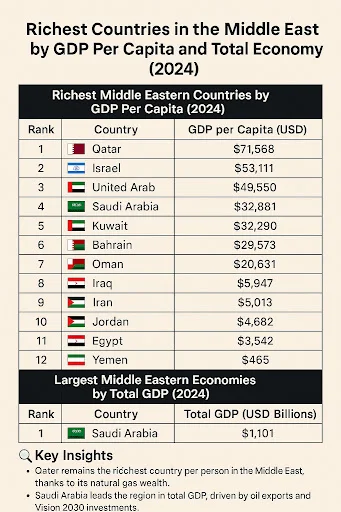
    Richest Countries in the Middle East by GDP Per Capita and Total Economy (2024)

    The Middle East is home to some of the wealthiest nations in the world. In this article, we compare countries by two key economic metrics: GDP per capita and total GDP. These rankings help identify the richest countries in the region in 2024.

    🏆 GDP Per Capita: Highest Earning Countries in the Middle East (2024)

    Rank Country GDP per Capita (USD)
    1🇶🇦 Qatar$71,568
    2🇮🇱 Israel$53,111
    3🇦🇪 United Arab Emirates$49,550
    4🇸🇦 Saudi Arabia$32,881
    5🇰🇼 Kuwait$32,290
    6🇧🇭 Bahrain$29,573
    7🇴🇲 Oman$20,631
    8🇮🇶 Iraq$5,947
    9🇮🇷 Iran$5,013
    10🇯🇴 Jordan$4,682
    11🇪🇬 Egypt$3,542
    12🇾🇪 Yemen$465

    Source: Visual Capitalist

    💰 Total GDP: Largest Middle Eastern Economies by Size (2024)

    Rank Country Total GDP (USD Billions)
    1🇹🇷 Turkey$1,344
    2🇸🇦 Saudi Arabia$1,101
    3🇦🇪 United Arab Emirates$536.8
    4🇮🇱 Israel$530.1
    5🇮🇷 Iran$469.1
    6🇪🇬 Egypt$469.1
    7🇶🇦 Qatar$235.5
    8🇰🇼 Kuwait$183.6
    9🇮🇶 Iraq$108.9
    10🇴🇲 Oman$108.9

    Source: Wikipedia

    🔍 Key Economic Insights for 2024

    • Qatar remains the richest country per person in the Middle East, thanks to its natural gas wealth.
    • Saudi Arabia leads the region in total GDP, driven by oil exports and Vision 2030 investments.
    • UAE combines oil, tourism, and finance for a balanced economic power.

    Conclusion

    From oil-rich Gulf states to tech-driven economies like Israel, the Middle East shows economic diversity in 2024. Understanding GDP per capita and total GDP helps compare national wealth and development in the region.

    ¿Humo negro en el Vaticano?

    ¿Esto significa que aún no hay nuevo Papa?

    Hoy, todas las miradas del mundo católico estaban puestas en la chimenea de la Capilla Sixtina. 

    Como ocurre en cada cónclave, el humo que sale de allí indica si los cardenales han logrado o no elegir a un nuevo Papa. 

    Y esta vez, el humo fue negro.

    ¿Qué significa el humo negro?

    El humo negro es la señal de que no se ha alcanzado un consenso suficiente entre los cardenales. 

    Para elegir a un nuevo Pontífice, se requiere una mayoría calificada: al menos dos tercios de los votos. 

    Si tras una ronda de votaciones no se logra este número, las papeletas se queman junto con una sustancia química que produce el característico humo oscuro. 

    Es la manera en que el Vaticano comunica al mundo que aún no hay Papa.

    ¿Cómo funciona el cónclave?

    El cónclave es una reunión secreta y solemne que se celebra en la Capilla Sixtina, en el Vaticano. 

    Allí, los cardenales electores —aquellos menores de 80 años— votan en silencio y en oración para discernir quién debe ser el nuevo líder espiritual de más de mil millones de católicos en todo el mundo.

    Las votaciones se realizan hasta cuatro veces al día: dos por la mañana y dos por la tarde. 

    Después de cada sesión, se libera humo por la chimenea: negro si no hay elección, blanco si ya hay nuevo Papa.

    La espera continúa

    La fumata negra de hoy nos recuerda que el proceso sigue en marcha. 

    Elegir al Papa no es una decisión política ni una simple votación: es una búsqueda guiada por la fe, la experiencia y el consenso espiritual entre los cardenales.

    Millones de fieles alrededor del mundo esperan con esperanza la próxima fumata, deseando que pronto el cielo del Vaticano se ilumine con humo blanco, anunciando: "Habemus Papam".

    India attacked Pakistan with missiles

    India has launched a military campaign called “Operation Sindoor”, targeting nine alleged militant locations across Pakistan and Pakistan-administered Jammu and Kashmir

    According to media reports, airstrikes were carried out at five key locations: Kotli, Bahawalpur, Muridke, Bagh, Muzaffaraba.


    Pakistan’s military has confirmed the attacks, stating that missiles were fired at different sites, resulting in 2 deaths and 12 injuries

    Islamabad has condemned the strikes and warned that it will respond accordingly.

    The name “Operation Sindoor” carries symbolic meaning. Sindoor, a red powder traditionally worn by married Hindu women, appears to be a pointed reference to the April 22 attack in Pahalgam, located in Indian-administered Kashmir, where 26 people—mostly tourists—were killed

    India suggests the operation is a response to that attack.


    Diabetic-Friendly Meal Idea (for 1–2 people)

    Main Dish: Grilled chicken or tofu with sautéed vegetables

    Side: Small serving of quinoa or brown rice (½ cup cooked)
    Salad: Leafy greens + cucumber + tomatoes + olive oil + lemon
    Snack/Dessert: Handful of nuts or unsweetened Greek yogurt with a few berries


    🛒 Grocery List

    Proteins:

    • Chicken breast or tofu

    • Eggs

    • Unsweetened Greek yogurt

    • Lentils or chickpeas

    Vegetables (non-starchy):

    • Spinach, kale, or lettuce

    • Bell peppers

    • Broccoli or cauliflower

    • Cucumber, tomato, zucchini

    • Onion, garlic

    Healthy Carbs (in small portions):

    • Quinoa, brown rice, or sweet potato

    • Whole oats (for breakfast)

    Healthy Fats:

    • Olive oil

    • Nuts (almonds, walnuts)

    • Avocados

    Extras:

    • Spices (turmeric, cumin, black pepper)

    • Lemon or vinegar (for dressings)


    🕘 Sample Daily Plan (Simple)

    Breakfast:

    • 2 boiled eggs + sautéed spinach

    • 1 slice whole-grain bread or ½ cup oats

    Lunch:

    • Grilled chicken/tofu + mixed veggies + ½ cup quinoa

    • Salad with olive oil & lemon

    Snack (optional):

    • A handful of almonds or a boiled egg

    Dinner:

    • Lentil soup or chickpea curry with veggies

    • Small serving of brown rice or 1 roti (whole wheat, if tolerated)


    Daily Diabetes Log Template

    Time Blood Sugar (mg/dL) What You Ate/Drank Exercise (mins/type) Notes (Stress, Sleep, etc.)
    Fasting (morning)
    Before Lunch
    2h After Lunch
    Before Dinner
    2h After Dinner
    Bedtime

    7-Day Low-GI Diabetic Meal Plan

    Day 1

    • Breakfast: 2 boiled eggs + sautéed spinach, 1 small whole wheat toast
    • Lunch: Grilled chicken/tofu + mixed vegetables + ½ cup brown rice
    • Snack: Handful of almonds
    • Dinner: Moong dal + sautéed okra + 1 multigrain roti

    Day 2

    • Breakfast: Plain oats with chia seeds and a few nuts
    • Lunch: Rajma + salad + ½ cup brown rice
    • Snack: 1 boiled egg or unsweetened yogurt
    • Dinner: Stir-fried paneer + spinach + 1 whole wheat roti

    Day 3

    • Breakfast: Besan chilla with veggies + mint chutney
    • Lunch: Grilled fish or tofu + steamed broccoli + salad
    • Snack: Cucumber sticks with hummus
    • Dinner: Masoor dal + cabbage stir-fry + 1 small jowar roti

    Day 4

    • Breakfast: 1 egg + ½ avocado on whole-grain toast
    • Lunch: Chicken curry (light oil) + sautéed green beans + ½ cup quinoa
    • Snack: Roasted chana
    • Dinner: Moong khichdi + salad

    Day 5

    • Breakfast: Upma (with veggies and less oil)
    • Lunch: Sambar + 1 small ragi dosa + vegetable curry
    • Snack: Buttermilk (unsweetened)
    • Dinner: Tofu bhurji + lauki sabzi + 1 whole wheat roti

    Day 6

    • Breakfast: Sprouts salad with lemon + 1 boiled egg
    • Lunch: Chickpea salad + small bowl of curd + 1 small millet roti
    • Snack: A few walnuts or 1 small apple
    • Dinner: Vegetable soup + stir-fried paneer or chicken

    Day 7

    • Breakfast: Dalia (cracked wheat) with vegetables
    • Lunch: Bhindi + dal + salad + 1 small whole wheat roti
    • Snack: Green tea + a few peanuts
    • Dinner: Grilled tofu or fish + steamed broccoli + small brown rice serving
    Book & Save: Tiqets Kiwi GetYourGuide Amazon
    Advertisement
    AI Advisor — Ask me anything
    Stays active all session
    Hi! Ask me about travel, immigration, Spain, India, or any topic on Latestfoto.com. I find posts, affiliate deals, and follow-up questions for you.
    Best places in Spain? Cheap flights Madrid US immigration 2026 India travel guide Free tours Europe
    ✨ Free AI Skin Analysis! Try Now →

    Flight

    ✈️ Flight Deals

    Error fares & cheap flights — updated daily

    Loading flight deals…

    _________________
    facebook

    Featured Post

    Ruta de Lubián a Vilavella

    Ruta de Lubián a Vilavella : un recorrido espectacular entre montañas, bosques y paisajes rurales en el noroeste de España. 🌿🥾 Este trayec...

    Last 30 days' visitors

    AI Advisor
    AI Advisor

    Look what is published:

    Try Desktop
    Purchase from

    chat

    Ask a Question

    Enhance Your Success with Increased Visitor Engagement!
    Ready to leave your mark? Partner with us and witness your business flourish!

    7 Days-Popular Articles


    How to Find Articles Relevant to Your Interest.

    Top Internet Search Topics.

    Join Our Writing Community!

    🚀✍️ Embrace your passion for words and turn your free time into an exciting writing adventure & earning! Collaborate with us and elevate your writing game. 🌟

    🚀✍️ Explore the world of guest writing and enjoy the added bonus of a backlink to your blog. Let's create captivating content together! 🌟

    Scan QR code. Buy me a coffee.

    Enjoying This Website?

    Give Us Your Vote!

    Follow Us on Facebook

    Follow Us on Facebook

    Follow Us Now!

    Buy & Sell Your Video

    Have an interesting video? Earn money by sharing it with us.

    Learn a Language for Travel, PR, or Citizenship

    Offer Your Own Language
    -------------------------
    See More. Do More. Share More.
    Join Our Newsletter

    Get exclusive discounts & travel tips straight to your inbox.

    Please type this word to confirm you're human:

    © Latestfoto.com — Questions. Curiosity. Discoveries.