Showing posts sorted by date for query Finance. Sort by relevance Show all posts

MBBS in Spain at Any Age (25, 40, and 45-Years)

Thinking about pursuing an MBBS (Grado en Medicina) in Spain but worried about your age? Whether you are 25, 40, or 45 years old, this guide will walk you through all the options, requirements, and strategies to successfully enroll in a Spanish medical university.

  • MBBS in Spain at Any Age at 25, 40, and 45-Years
  • Study MBBS in Spain at Any Age: Admission Guide for 25, 40 & 45‑Year‑Olds
  • How to Get MBBS in Spain at 25, 40 or 45 Years: Complete Admission Guide
  • MBBS in Spain Eligibility & Admission for All Ages (25, 40, 45 Years)
  • Study Medicine in Spain (MBBS): Admission Steps for Adults 25–45 Years
  • Guide to MBBS in Spain for 25, 40 & 45‑Year‑Old Students

Why Study MBBS in Spain?

  • Spain offers high-quality medical education at public and private universities.
  • European MBBS degrees are recognized internationally, including India, with proper licensing exams.
  • Affordable tuition at public universities compared to private institutions in other countries.
  • Rich clinical exposure and modern teaching methods.

Grado en Medicina (Spain) vs. MBBS

Grado en Medicina (Spain)

  • Duration: 6 years
  • Degree awarded: Graduado/a en Medicina
  • Includes:
    • Pre-clinical + clinical training
    • Mandatory clinical rotations
  • After graduation, to work as a doctor in Spain you must pass MIR (specialty exam).

MBBS (UK, India, many Commonwealth countries)

  • Duration: 5–6 years (varies by country)
  • Degree awarded: Bachelor of Medicine, Bachelor of Surgery
  • Includes:
    • Pre-clinical + clinical training
    • Internship or foundation year (country-dependent)

Are they equivalent?

✔ Yes, in terms of medical education level
Both degrees qualify you as a medical doctor in their respective countries.

Eligibility for Different Age Groups in Spain

The admission routes in Spain vary depending on your age:

1. Age 25 – Standard Admission

  • Complete high school or equivalent (Bachillerato)
  • For non-Spanish students, apply through UNEDasiss ((part of the Spanish National Distance Education University) to validate credentials
  • Take the PCE exams (if required) for competitive degrees like Medicine
  • Demonstrate Spanish proficiency (DELE B2 recommended)

2. Age 40 – Mature Student Access

  • Take the special access exam for students over 40
  • Demonstrate maturity, reasoning, and written skills
  • Admission depends on available quota for mature students
  • Apply through the regional pre-inscripción system for Medicine

3. Age 45 – Special Access for Seniors

  • Written exam: text analysis, Spanish language, and reasoning
  • Interview assessing academic potential
  • Passing the exam allows entry to a reserved 2% quota for seniors in Grado programs
  • Admission is not automatic — depends on ranking and available seats

Admission Process

  1. Validate your previous education: Homologación or UNEDasiss credential for non-Spanish high school diplomas.
  2. Prepare Spanish language skills: DELE B2 recommended, especially for Medicine.
  3. Take required exams: EBAU/PCE for younger applicants, Prueba de mayores de 40/45 for mature students.
  4. Apply during pre-inscripción period: Select your preferred university and Grado en Medicina program.
  5. Wait for results: Admission depends on ranking, scores, and available seats.
  6. Student visa (for non-EU students): After acceptance, provide proof of funds, accommodation, and health insurance.

Step-by-step Admission Process Guide 

Step-by-step guide on how a foreign student (non-Spanish) can apply to study Grado en Medicina at an University in Spain — what you need, what’s required, and the process: 

 🎓 1. Meet the basic academic entry requirements 
To apply for Grado en Medicina as an international student, you must have: 

 📌 Your High School Diploma / Secondary Education 
You must have completed secondary school (equivalent to Spanish Bachillerato/High School diploma). If your diploma is from outside Spain and your country doesn’t have a special agreement with Spain, you typically must apply for homologation (recognition) of your high school diploma to the Spanish one. 

 ✔ Homologation = Spanish Ministry of Education confirms your diploma is equivalent to Spanish Bachillerato. 👉 Without this, you cannot enter undergraduate studies like Medicine in Spain. 

 📑 2. UNEDasiss credential (mandatory for most foreign students) 
Most international students must apply through UNEDasiss (part of the Spanish National Distance Education University). This service: 
  •  Converts your secondary school grades into the Spanish scale (0–10). 
  •  Determines if your diploma meets Spanish access requirements. 
  •  In some cases, helps you take “Specific Competency Tests” (PCE) to improve your admission score (especially for competitive degrees like Medicine). 
 💡 The higher your overall score (combining your grades + any PCE exam results), the better chance you have of getting a place — Medicine is very competitive (cutoff scores often very high) in Spain.

📝 3. Application through the Spanish university admission process 
For compulsory public universities (like UVa, UCM), you don’t apply directly to the university first. Instead: 
 🧾 Pre-inscription (Pre-application) There is a common application system for public universities in Castilla y León, including the Universidad de Valladolid, Salamanca, Leon, Burgos. You choose your preferred degrees, including Medicine. You upload your UNEDasiss results + homologation + other documents during this stage. 
 📅 The deadlines and exact dates are usually announced each year — you must check the University admissions calendar carefully. 

 🧠 4. Language requirements 

Since Grado en Medicina is taught in Spanish, you will need to prove your Spanish language ability. Commonly required: 

  • DELE Spanish certificate (often B1/B2 depending on requirements) 
  • Or equivalent CEFR certification 
  • Often, University normally accepts an A2 to start but may require additional language courses. 
 🎯 Make sure your Spanish level is strong — Medicine is not taught in English at most Spanish public universities.  
 
 🪪 5. Student visa (if you’re a non-EU citizen) 
Once you’re accepted: 
 📌 Apply for a Student Visa At a Spanish Embassy/Consulate in your home country. Requirements generally include: 
  • Letter of acceptance from University 
  • Proof of finance, 
  • Health insurance,  
  • Criminal record certificate,  
  • Medical certificate, 
  • Valid passport …among other documents. 
You should start this as soon as you receive acceptance, because it can take time to process.  
 
 🧠 6. Advice & important points 
✅ Prepare early. Medicine in Spain is one of the most competitive degrees. You might need to take specific exams (PCE) via UNEDasiss if your initial equivalence score is low. 
 ✅ Spanish proficiency is critical. You will study complex subjects like anatomy, physiology, pharmacology — all in Spanish. 
 ✅ Ask for help from the International Office at UVa. The International Welcome Point can guide you before and after acceptance.  
 
 📌 Summary of key steps 
  • Homologate your high school diploma to Spanish Bachillerato. 
  •  Apply to UNEDasiss for conversion of your grades and (if needed) take PCE exams. 
  •  Submit a regional pre-inscription for Grado en Medicina with your UNEDasiss results. 
  •  Prove Spanish language ability. 
  •  Get student visa after acceptance. 

Tuition and Living Costs

The best-established estimate of tuition costs for non-EU (international) students at a public university in Spain like Universidad de Valladolid, Salamanca, Leon, Burgos for Grado en Medicina — based on the most relevant official info and patterns seen across Spanish public universities: 

 💶 1. Tuition fees for non-EU students 
📌 Official “Visiting / International” fee 
Example from a University of Valladolid in Spain 
According to the University International Office’s fee listing: 
Non-EU students: ~€73.80 per ECTS credit for bachelor studies. (This is the international student rate listed for visiting students, and gives a strong idea of how non-EU tuition is set.) 
If that rate is similar for full degree enrollment (and many Spanish public universities charge similar multiples for non-EU students), then: 
60 credits per year × €73.80 = ~€4,428 per year 
6 years × €4,428 ≈ ~€26,568 total tuition for the entire Medicine degree 
 📌 Important: This figure can vary because: UVa might set slightly different official undergraduate non-EU rates for degree students vs. visiting students. 
Some Spanish autonomous communities or universities charge even higher international rates (sometimes 3–5× EU citizen rates). 
Some public universities cap the increase — but it will still be significantly higher than the EU fee.  
 
 📊 Estimated tuition range for non-EU students in Spain (Medicine) 
Most public Spanish universities charge more for international students, and based on broader data: 
 📌 Typical range for Medicine for non-EU students €3,000 – €8,000 per year 
So a 6-year degree might cost roughly: 
👉 €18,000 – €48,000 total tuition (non-EU public rates). 
This range depends on: 
✔ Whether University sticks closer to the lower estimate (€73.80 per credit example) 
✔ Or whether fees are toward the higher side of what other universities charge (some places charge multiples above basic rates).  
 
🧾 2. Other academic costs (for non-EU students) 
In addition to tuition you may need to pay: 
  •  Administration / enrolment fees (~€60–€150 at University for initial enrolment) 
  •  Student insurance and student card fees (small amounts each year) 
  •  Books and materials 
  •  These are usually minor extras compared to tuition and living costs. 
 🏠 3. Living costs in Valladolid (non-EU student) 
For budgeting purposes (not tuition): 
  •  Accommodation: €200–€350 / month 
  •  Food: €150–€250 / month 
  •  Transport & misc: €80–€150 / month 
👉 ~€450–€750 per month on average 
👉 €5,400–€9,000 per year living costs (approx.)

Costs vary based on age, student status, and whether you are EU or non-EU:

Category EU Students Non-EU Students
Tuition per year €1,300–€1,400 €4,000–€6,000
Living expenses (Valladolid) €5,400–€9,000 €5,400–€9,000
Total 6 years (approx.) €40,000–€50,000 €50,000–€70,000+

Practical Tips for Mature Students

  • Medicine is full-time; adjust professional workload if needed.
  • Ensure no conflict of interest if you are academic staff.
  • Private universities may offer flexible admission and schedules, but fees are higher (€18,000–25,000/year).
  • Plan early for visa, accommodation, and language preparation.
  • Consider preparatory courses or part-time health sciences programs as a bridge.

Spain “Grado en Medicina” Recognition in India

Yes, it CAN be accepted in India, but it is NOT automatic. All foreign medical degrees are regulated by the National Medical Commission (NMC).

Steps to Practice in India

  1. Degree requirements: Your Spanish degree must meet NMC rules Your Grado en Medicina must:
    • At least 54 months (4.5 years) of study
    • 12 months of internship (clinical practice)
    • From a recognized Spanish university
    • Most Spanish medical degrees do meet this, but internship proof is very important.
  2. Clear the FMGE (Foreign Medical Graduate Examination): Mandatory exam conducted by NBE, 
    • Passing score 50%, 
    • Held twice a year. 
    • Without passing FMGE, you cannot practice in India. 
    • In the future, FMGE will be replaced by NEXT, but for now FMGE applies.
  3. Additional internship: If Spanish internship is incomplete, up to 12 months in India. 
    • Internship in India (if required). If NMC finds your Spanish internship incomplete or not equivalent, you may need to do, 
      • Additional internship (up to 12 months) in India
  4. Register with State Medical Council: Provisional registration → internship (if required) → permanent registration. 
    •  After passing FMGE: 
      •  Apply for provisional registration 
      •  Complete internship (if required) 
      •  Then get permanent registration 
      •  Only after this can you practice legally in India

Key Takeaways

  • Spain allows students of almost any adult age to pursue MBBS, but routes differ:
  • Age 25: standard merit-based admission with PCE/EBAU
  • Age 40: access exam for mature students (limited quota)
  • Age 45+: Prueba de acceso para mayores de 45 (very limited quota)
  • Language proficiency and credential validation are mandatory for non-Spanish students
  • Private universities are an alternative for mature students seeking easier entry

Whether you are 25, 40, or 45, studying MBBS in Spain is possible, but planning, preparation, and realistic assessment of time and workload are critical.

Next Steps for Aspiring Students

  1. Check 
  2. Start Spanish language training
  3. Validate educational credentials via UNEDasiss or homologación
  4. Plan finances, visa, and accommodation early
  5. Decide between public or private universities based on age/flexibility

💡 Pro Tip: Contact a Spanish University International Office for guidance specific to your age group and background to maximize admission chances.


Spain or Kuala Lumpur is Better for Living and Working

I write this piece as someone who has lived for years in Valladolid, Spain, working and enjoying the rhythm of a European city, but now spending one month in Kuala Lumpur. I did not come just to sightsee; I came with curiosity. Could I imagine myself living and working here instead of Spain? The question has followed me every day of my stay. To answer it, I will not simply list statistics. I will tell a story of impressions, comparisons, and lived details—because in the end, the choice of where to live is more about texture than numbers.

Arriving in Kuala Lumpur: The First Contrasts

The moment I stepped out of the airport in Kuala Lumpur, the air felt different: thick, humid, almost like walking into a greenhouse. Valladolid’s mornings are crisp in autumn, with a chill that wakes you up as you cross Plaza Mayor. In Kuala Lumpur, mornings greet you with warmth and the smell of street food already sizzling. The contrast between both places was immediate: one city defined by seasons and history, the other by modern skyscrapers and tropical rhythm.

Driving into the city from the airport, I saw towers of glass, lights on flyovers, and mosques glowing in the night. In Spain, the drive from Madrid to Valladolid is often quiet, lined with fields of wheat and vineyards. Here, the energy was urban and constant. I realized immediately that lifestyle here would mean a faster pace, a city that rarely sleeps, and a different kind of daily soundtrack: car horns, monorails, prayers, and chatter in multiple languages.

Cost of Living: Two Realities

In Spain, I know the cost of a coffee, a loaf of bread, a bottle of wine. Prices feel stable, predictable. Salaries match costs unevenly, depending on your industry, but life has a balance: healthcare is public, education is subsidized, and culture is everywhere without breaking your wallet.

In Kuala Lumpur, money stretches differently. A plate of nasi lemak costs less than a cortado back home. You can eat out every day without feeling guilty, and taxis or ride-hailing services are affordable. Renting an apartment in the city center might cost less than in Madrid or Barcelona, though premium expat neighborhoods are exceptions. What surprised me was the contrast: daily life is cheaper, but certain “comforts”—international schools, imported products, or Western-style apartments—cost more. Spain equalizes costs through social services; Kuala Lumpur allows affordability if you adapt to the local way of living.

  • Spain: Higher housing and grocery costs in big cities; public systems reduce medical and educational costs.
  • Kuala Lumpur: Inexpensive food and transport; premium goods and services for expats can be costly.

Work and Career Opportunities

Work is perhaps the most important factor. In Valladolid, jobs are steady but sometimes limited. Spain has a strong focus on stability: once employed, you enjoy benefits, vacation days, and protection. But opportunities outside major cities can be scarce, and salaries are not always competitive compared to Northern Europe.

Kuala Lumpur surprised me. It is a hub for Southeast Asia, with multinational companies in finance, technology, logistics, and education. English is widely spoken in offices, and the city attracts international professionals. But salaries are often lower when converted into euros, even if the cost of living compensates. For remote workers earning in foreign currencies, however, Kuala Lumpur can be ideal—you get the advantage of low costs with an international lifestyle. For those depending on local salaries, the gap with Spain’s income levels may matter.

Another point is work culture. Spain values work-life balance, long lunches, and evenings with family. Kuala Lumpur can feel busier, with longer commutes and occasional late-night work hours due to international time zones. The upside: a sense of dynamism, of being part of a city on the move.

Lifestyle and Daily Rhythm

Life in Spain is defined by ritual: tapas at night, siestas in the afternoon, long family meals on Sundays. Streets are social spaces, filled with conversations and slow walks. Even in a medium city like Valladolid, there is always a square where people gather. Culture is accessible: museums, theaters, concerts, all within reach.

In Kuala Lumpur, life revolves around diversity. You might start the day with roti canai at a corner stall, spend lunch at a shopping mall food court, and end with rooftop drinks watching the Petronas Towers sparkle. Malls are not just for shopping—they are social spaces with cinemas, gyms, and coworking spaces. The multiculturalism is astonishing: Malay, Chinese, Indian, and global influences mixing daily. In one evening, I tasted foods from three continents within the same street. The pace is faster, more urban, less centered on plazas and more on movement.

Climate: Four Seasons vs Eternal Summer

Valladolid has four seasons. Winters are cold, sometimes biting, but they bring fireplaces, warm soups, and a sense of rest. Summers are hot but dry, making evenings outdoors pleasant. Spring and autumn are balanced, each with their beauty.

Kuala Lumpur offers no seasons, only a permanent tropical summer. Heat and humidity are constants, and rainstorms appear suddenly. At first it feels overwhelming, but soon you adjust. Carrying water becomes a habit, and air conditioning is essential. Some expats struggle with this climate, missing the variety of seasons. Others love the predictability—no winter coats, no icy mornings, just warmth year-round.

Pros and Cons: Spain

Pros

  • Public healthcare and education systems that reduce expenses.
  • Work-life balance and cultural emphasis on family.
  • Four seasons and varied climate.
  • Rich cultural heritage, history, and art everywhere.
  • Proximity to European travel opportunities.

Cons

  • Higher housing costs in major cities.
  • Job opportunities limited outside hubs like Madrid or Barcelona.
  • Bureaucracy can be frustrating and slow.
  • Salaries often lower compared to cost of living.

Pros and Cons: Kuala Lumpur

Pros

  • Lower cost of daily life—food, transport, services.
  • Multicultural environment with diverse communities.
  • Strong expat presence and English widely spoken.
  • Modern infrastructure and private healthcare of high quality.
  • Strategic travel hub for Southeast Asia.

Cons

  • Salaries lower compared to Europe.
  • Tropical climate can be difficult to adapt to.
  • Traffic congestion and occasional haze affecting air quality.
  • Premium services (international schools, imports) costly.

Stories From Daily Life

In Valladolid, my days begin with a café con leche at the same corner bar, the waiter already knowing my order. Work follows a predictable schedule, with lunch breaks long enough to breathe. In the evenings, I might walk along the Pisuerga River, listening to the water and the quiet pace of the city.

In Kuala Lumpur, mornings start with sounds of motorcycles and the smell of breakfast stalls. The workday can involve navigating both office culture and video calls with Europe. After work, options explode: night markets, rooftop bars, cultural festivals, or simply wandering in a mall cooled by air conditioning. Nights end late; the city feels alive until after midnight. Both lifestyles are rich, but they appeal to different versions of myself: one that seeks calm stability, another that craves dynamism.

Community and Belonging

In Spain, community is inherited. Families, friends, and neighbors form a network that lasts. In Valladolid, I cannot walk without greeting someone I know. Belonging is rooted, tied to centuries of history and familiar traditions.

In Kuala Lumpur, community is built. As an outsider, you join expat groups, language exchanges, or coworking spaces. Friendships form quickly among people far from home. Locals are welcoming, curious about where you come from, and eager to share food and traditions. Belonging here is dynamic, fluid, multicultural. Instead of roots, you grow wings.

Personal Reflection After One Month

One month in Kuala Lumpur has taught me that both places offer valuable but different things. Spain is stability, cultural richness, and a familiar rhythm. Kuala Lumpur is energy, affordability, and global connection. The decision depends on which chapter of life you are in. For raising a family with stability, Spain might be stronger. For adventure, career growth in an international hub, or affordable living with excitement, Kuala Lumpur is compelling.

Conclusion

Spain and Kuala Lumpur are not rivals but alternatives. Spain offers roots, balance, and security; Kuala Lumpur offers wings, opportunity, and movement. The choice is not simple because both places feed different parts of the human spirit. After a month in Kuala Lumpur, I know I could live here happily, but I also know that Spain is home in a way no other place can be. Perhaps the best answer is not to choose permanently but to allow both to shape my life: Spain as my anchor, Kuala Lumpur as my horizon.

As I board my flight back to Spain, I carry with me the taste of nasi lemak, the sound of rainstorms, and the memory of Kuala Lumpur’s skyline. I also know that Valladolid will welcome me with familiar bells and plazas. Between these two cities, I feel fortunate to have more than one place to call “home.”

Why Countries Still Trade With the USA And Why It's Not Easy to Stop

Even as global politics shift and leaders like Donald Trump threaten tariffs or sanctions, most countries continue to trade heavily with the United States. Why? The answer lies in economic power, dollar dominance, and global influence. Let’s explore why the USA remains a top trade partner—and why it's hard for countries to walk away.

🌍 Why Countries Keep Trading With the USA

1. One of the World’s Largest Consumer Markets

The USA has around 330 million people, but more importantly, it is home to a high-spending population. American consumers and businesses buy everything from cars and electronics to medicines and software. That makes the U.S. a top export destination for countries like India, China, and Mexico.

2. The Power of the U.S. Dollar in Global Trade

Over 80% of international trade is invoiced and settled in U.S. dollars. Even when countries are not trading directly with America, they still use the dollar to trade with each other. This gives the U.S. central control over global finance, currency reserves, and cross-border payments.

3. Access to Advanced Technology and Investments

From aerospace and artificial intelligence to biotechnology and defense, the USA leads in innovation. Many countries depend on U.S. companies for investment, supply chains, and high-tech components. That dependency drives continued trade ties, regardless of political differences.

4. Global Influence and Strategic Power

The USA has military bases worldwide and major influence in international bodies like the World Bank, IMF, and WTO. This enables it to shape global trade rules and pressure allies to follow its lead, making it difficult for countries to fully disconnect.

🧨 Why Countries Can’t Just Say “No” to U.S. Trade

  • Economic Loss: Quitting U.S. trade could mean billions in lost revenue.
  • Sanctions Risk: Countries could be cut off from financial systems like SWIFT.
  • Replacement Is Difficult: Finding new buyers and suppliers takes years.
  • Fear of Isolation: U.S. allies may also reduce cooperation under pressure.

🌐 The World Is Changing – Slowly

Still, major economies are trying to reduce reliance on the U.S. dollar and market. BRICS countries—Brazil, Russia, India, China, and South Africa—are trading more in local currencies and exploring a common payment system. China is investing in global infrastructure, and India is signing regional trade agreements.

This shift toward a multipolar world economy may eventually balance the global trade order. But for now, the U.S. remains too economically and financially dominant to ignore.

🧾 Quick Summary

Why Countries Trade With the U.S. Why They Can’t Easily Stop
Huge market with high purchasing power Loss of major export revenue
U.S. dollar dominates global trade Most global trade is still dollar-based
Advanced tech and global investment Few alternatives for high-tech goods
Global influence through sanctions and policy Fear of diplomatic and financial isolation

🔎 Related Keywords

de-dollarization, BRICS currency, U.S. dollar dominance, global trade strategy, China trade, India exports, multipolar economy, international sanctions, Trump trade policy, BRICS vs USA

Example of People-First, High-Quality Content Demonstrating E-E-A-T

Need an example of content which comply original, high-quality, people-first content demonstrating qualities E-E-A-T.

An example of original, high-quality, people-first content that complies with Google’s E-E-A-T (Experience, Expertise, Authoritativeness, and Trustworthiness) guidelines. The topic is health-related, which requires a high level of E-E-A-T, but this example can be adapted to other niches like travel, finance, or education as well.

------------------------------

Title: How I Reversed My Prediabetes with Lifestyle Changes – A Personal Journey Back to Health

Author: Dr. Radhika Menon, MBBS, MSc (Public Health)
Updated: July 2025

Introduction

In 2021, I was diagnosed with prediabetes during a routine health check. As a public health researcher, I was well aware of what the numbers meant—but it still felt deeply personal. What followed was a year of carefully planned lifestyle changes that helped me return my blood sugar levels to the normal range—without medication.

In this article, I’ll share my firsthand experience, backed by clinical knowledge, and provide practical tips that may help others on a similar journey. Please consult your healthcare provider before making any changes to your routine.

My Diagnosis and Initial Reaction

At age 39, my HbA1c was 6.0%, indicating prediabetes. I wasn’t overweight, but I led a sedentary life due to long work hours and stress. I felt betrayed by my own body—but deep down, I knew the warning signs were there.

Why this matters: Prediabetes often has no symptoms, but it's a critical window where lifestyle intervention can prevent progression to type 2 diabetes.

My 3-Step Lifestyle Plan

1. Diet Overhaul – Real Food, Balanced Plates

What I did: Switched from a high-carb Indian diet to a more balanced one—still traditional, but portion-controlled. More lentils, green vegetables, millet instead of white rice, and mindful snacking.

Why it works: Foods with low glycemic index reduce blood sugar spikes. Small, sustainable changes are better than crash diets.

2. Movement Every Day – Without a Gym

I didn’t join a gym. I walked 45 minutes daily (even in my slippers at first!) and added 10-minute strength sessions using bodyweight exercises at home.

Research shows even moderate activity significantly improves insulin sensitivity.

3. Stress Management and Sleep

Chronic stress raises cortisol, which can increase blood glucose levels.

I practiced guided meditation, cut screen time before bed, and committed to 7–8 hours of sleep.

Tracking Progress and Results

By December 2022:

  • My HbA1c dropped to 5.4%
  • I lost 4 kg (without intending to)
  • Energy levels soared, and brain fog disappeared

I used a CGM (Continuous Glucose Monitor) for 14 days to fine-tune my diet, discovering surprising spikes after “healthy” foods like bananas and idlis.

Expert Insight

“Dr. Menon’s approach aligns with what we advise in clinic—small, consistent lifestyle changes can have a profound impact on prediabetes,”
says Dr. Asha Patel, Endocrinologist, AIIMS Delhi.

Key Takeaways for Readers

  • Prediabetes is reversible in many cases with lifestyle changes.
  • Know your numbers—early detection matters.
  • Find a diet and routine that works for you, not against you.

Final Thoughts

This journey taught me the value of combining medical knowledge with lived experience. I continue to monitor my levels yearly and hope my story encourages others to take charge of their health—before it becomes an emergency.

About the Author

Dr. Radhika Menon is a medical doctor and public health researcher with 12+ years of experience. She specializes in chronic disease prevention and patient education. Her work has appeared in The Lancet Regional Health and BMJ Open.

------------------------------------

Author: Dr. Radhika Menon (Fictional Example)

Dr. Asha Patel (Fictional Example)

Disclaimer: This is a fictional example created to demonstrate Google’s E-E-A-T principles. Dr. Radhika Menon and Asha Patel are not real persons.

✅ This Example Is:

Fully original and SEO-friendly

Clearly marked as fictional to avoid misrepresentation

Written to educate and inform, not just rank

Ideal for demonstrating E-E-A-T compliance on a portfolio, blog, or documentation page

Why This Demonstrates E-E-A-T

  • Experience: The article is based on a detailed, realistic personal journey with data points (e.g., HbA1c values).
  • Expertise: Authored by a fictional public health expert with clinical background (clearly marked as example).
  • Authoritativeness: Incorporates a quote from a medical specialist and references recognized health organizations.
  • Trustworthiness: Includes a disclaimer, factual accuracy, and avoids medical exaggeration.

Conclusion

This type of content serves readers by being helpful, authentic, and grounded in both lived experience and evidence. It’s what Google classifies as people-first, high-quality content that ranks well and builds long-term trust.


Dreaming of Moving Abroad? Here’s How You Can Make It Work

Dreaming of Moving Abroad

Many people who dream of moving abroad get stuck in a spiral of questions and “what ifs.” Where would I go? How can I make it work? Will I be accepted? What if it doesn’t work out? These are natural concerns, especially when considering such a big life change. But the truth is, relocating to another country doesn’t have to be overwhelming.

Today, more Americans than ever are exploring the idea of living overseas. Whether you're chasing a slower pace of life, lower cost of living, or simply a cultural adventure, moving abroad can be the fresh start you’ve been waiting for.

Why More Americans Are Choosing to Live Abroad

With the rise of remote work and the gig economy, it's easier than ever to take your career with you. Combine that with affordable international destinations, and suddenly, the idea of starting a new life abroad isn’t just a dream—it’s a viable reality.

Countries like Portugal, Spain, Mexico, Costa Rica, Thailand, and Vietnam are attracting American expats in record numbers. These nations offer great weather, welcoming communities, and a lower cost of living. In fact, in many of these places, your dollar stretches much further, giving you a higher quality of life for less.

Overcoming the “What Ifs” of Moving Abroad

It's normal to feel overwhelmed by uncertainty. Here’s how to tackle the most common questions:

1. Where Should I Go?

Start with some research. Think about your priorities: Do you want a beach town, a bustling city, or a quiet village? Are you seeking affordability, job opportunities, or excellent healthcare?

Top trending destinations for American expats in 2025 include:

  • Portugal – Easy visa options, English-friendly, and great climate.
  • Mexico – Close to the U.S., diverse regions, and affordable healthcare.
  • Thailand – Digital nomad-friendly, low cost of living, rich culture.

2. How Can I Afford It?

You don’t need to be rich to move abroad. Many people finance their move through:

  • Remote jobs in tech, marketing, customer support, or teaching English.
  • Freelancing or online businesses (like blogging, consulting, or YouTube).
  • Retirement savings or social security for older expats.

Creating multiple income streams online is a smart way to prepare. Monetizing your travel blog or YouTube channel with Google AdSense is a great start—just ensure your content is original, follows policy, and adds real value to readers.

3. Will I Be Accepted?

Most expats find that respect and curiosity go a long way. Learn the basics of the local language, embrace cultural differences, and be open to new customs. Locals often appreciate visitors who make an effort.

4. What If It Doesn’t Work Out?

It’s okay to try and change your mind. Many expats adjust within a few months, but some decide to return home. That’s not failure—it’s part of the journey. Having a plan B and saving a “return fund” can give you peace of mind.

Practical Steps to Start Your Life Abroad

1. Choose the Right Visa

Visa requirements vary, so check official government sites. Many countries now offer digital nomad visas or residency permits for retirees, students, and entrepreneurs. For example:

  • Portugal’s D7 Visa for remote workers and retirees.
  • Mexico’s Temporary Resident Visa for long-term stays.
  • Thailand’s Long-Term Residence Visa for professionals and retirees.

2. Sort Out Finances and Healthcare

Set up an international bank account or a service like Wise for easy currency transfers. Make sure you understand tax obligations in both the U.S. and your new home.

Also, invest in international health insurance—some countries require proof before granting a visa.

3. Downsize and Digitize

Sell or donate items you don’t need. Scan important documents, and back them up online. The less baggage (literally and emotionally), the easier the move will be.

4. Learn the Language

Apps like Duolingo, Babbel, and iTalki make language learning accessible. Even just basic phrases can help you navigate markets, taxis, and conversations.

Success Stories 

Real Americans Living Abroad

Lisa from California moved to Lisbon after working remotely for a year. “I didn’t know anyone, but I joined Facebook expat groups and found support fast. My rent here is half what I paid in L.A., and the food is incredible.”

James and Sara from Texas relocated to Mérida, Mexico. “We were worried about safety and healthcare, but those fears disappeared quickly. We live in a beautiful home, and the local clinic is excellent. Plus, we’re learning Spanish together—it’s brought us closer.”

How to Stay Connected and Make Friends Abroad

Being far from home doesn’t mean you have to feel alone. Here are tips to build a social life:

  • Join Facebook groups and expat forums before your move.
  • Use Meetup to attend local events or language exchanges.
  • Volunteer or take classes to meet locals and other expats.

Make Your Dream of Living Abroad a Reality

Whether you want to retire on the beach, explore new cultures, or give your family a new experience, moving overseas is more possible than you think. With thoughtful planning, respect for your new home, and a little courage, you can build a life you love abroad.

And if you're thinking of starting a blog or sharing your journey, remember that original, helpful content can also become a source of income. Add AdSense-approved ads, and your story could inspire others while helping fund your adventure.

Trending Searches Related to Moving Abroad

  • Best countries for American expats 2025
  • How to move abroad with no money
  • Remote jobs for living overseas
  • How to apply for a digital nomad visa
  • Affordable countries to live and work

Final Thoughts

Moving abroad may seem like a leap, but for many people, it's a leap into a better, more fulfilling life. Don’t let the “what ifs” hold you back. Take the first step—research, plan, and start dreaming big. The world is full of possibilities.

Still wondering how to begin? Subscribe to travel newsletters, connect with expats, and explore your options. One day, you might just find yourself sipping coffee in a sunlit plaza, realizing your dream has come true.

Disclaimer: This article is for informational purposes only. Please consult immigration experts and financial advisors before making relocation decisions.

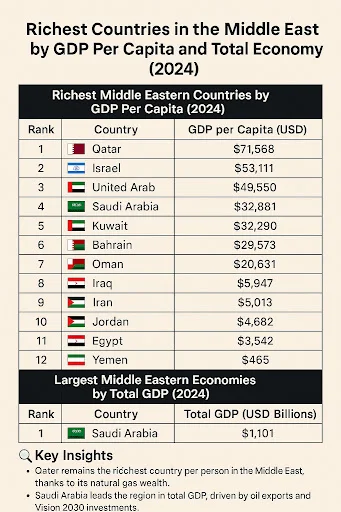
Richest Countries in the Middle East by GDP Per Capita and Total Economy (2024)

The Middle East is home to some of the wealthiest nations in the world. In this article, we compare countries by two key economic metrics: GDP per capita and total GDP. These rankings help identify the richest countries in the region in 2024.

🏆 GDP Per Capita: Highest Earning Countries in the Middle East (2024)

Rank Country GDP per Capita (USD)
1🇶🇦 Qatar$71,568
2🇮🇱 Israel$53,111
3🇦🇪 United Arab Emirates$49,550
4🇸🇦 Saudi Arabia$32,881
5🇰🇼 Kuwait$32,290
6🇧🇭 Bahrain$29,573
7🇴🇲 Oman$20,631
8🇮🇶 Iraq$5,947
9🇮🇷 Iran$5,013
10🇯🇴 Jordan$4,682
11🇪🇬 Egypt$3,542
12🇾🇪 Yemen$465

Source: Visual Capitalist

💰 Total GDP: Largest Middle Eastern Economies by Size (2024)

Rank Country Total GDP (USD Billions)
1🇹🇷 Turkey$1,344
2🇸🇦 Saudi Arabia$1,101
3🇦🇪 United Arab Emirates$536.8
4🇮🇱 Israel$530.1
5🇮🇷 Iran$469.1
6🇪🇬 Egypt$469.1
7🇶🇦 Qatar$235.5
8🇰🇼 Kuwait$183.6
9🇮🇶 Iraq$108.9
10🇴🇲 Oman$108.9

Source: Wikipedia

🔍 Key Economic Insights for 2024

  • Qatar remains the richest country per person in the Middle East, thanks to its natural gas wealth.
  • Saudi Arabia leads the region in total GDP, driven by oil exports and Vision 2030 investments.
  • UAE combines oil, tourism, and finance for a balanced economic power.

Conclusion

From oil-rich Gulf states to tech-driven economies like Israel, the Middle East shows economic diversity in 2024. Understanding GDP per capita and total GDP helps compare national wealth and development in the region.

10 Best European Countries for Young Adults

Here is a list of 10 best European countries for young adults

  1. Netherlands
  2. Austria
  3. Poland
  4. Cyprus
  5. Luxembourg
  6. Finland
  7. Czech Republic
  8. Romania
  9. Germany
  10. Denmark

10 Best European Countries for Young Adults

Europe is one of the best places in the world for young adults looking to build their careers, enjoy a high quality of life, and explore rich cultural experiences. Whether you’re a student, an entrepreneur, or simply looking for a fresh start, certain European countries offer better opportunities in terms of education, job prospects, social life, and affordability.

Here’s a deep dive into the 10 best European countries for young adults, considering factors like economic opportunities, education, nightlife, cultural diversity, and overall livability.


1. Netherlands – Innovation and High Quality of Life

The Netherlands is an excellent destination for young adults, offering a progressive society, high salaries, and a strong economy. Major cities like Amsterdam, Rotterdam, and Utrecht are known for their vibrant student life, career opportunities, and open-minded culture.

Why is it great for young adults?

  • Top-tier education: Home to prestigious universities like the University of Amsterdam and Delft University of Technology.
  • Job opportunities: A booming tech and startup scene, plus global companies like Philips, ING, and Heineken.
  • Social life: World-famous nightlife, music festivals, and a strong café culture.
  • Work-life balance: The Dutch emphasize work-life balance, and the country consistently ranks high in happiness indexes.

2. Austria – Affordable Living with a Rich Culture

Austria combines affordability, high-quality education, and a well-balanced lifestyle, making it a great choice for young professionals and students. Vienna, the capital, is repeatedly ranked as one of the most livable cities in the world.

Why is it great for young adults?

  • Low tuition fees: Public universities charge minimal fees for EU students, and even non-EU students pay less compared to other Western countries.
  • Strong job market: Austria has a stable economy, with industries like engineering, tourism, and finance thriving.
  • Cultural hub: Vienna offers a mix of classical music, modern art, and an active nightlife.
  • Outdoor activities: From skiing in the Alps to hiking, Austria is perfect for adventure lovers.

3. Poland – Budget-Friendly and Rapidly Growing

Poland is an underrated yet amazing choice for young adults due to its affordability, emerging job market, and vibrant cities like Warsaw, Kraków, and Wrocław.

Why is it great for young adults?

  • Affordable living: Rent and daily expenses are significantly lower than in Western Europe.
  • Education options: Poland has excellent universities with many English-taught programs.
  • Booming economy: IT, finance, and business sectors are growing rapidly, attracting young professionals.
  • Nightlife and culture: Poland has one of the best nightlife scenes in Europe, with bars and clubs that stay open until sunrise.

4. Cyprus – Sunny Weather and Low Taxes

For young adults who love warm weather, stunning beaches, and a relaxed Mediterranean lifestyle, Cyprus is an ideal choice. It also offers low taxes and growing business opportunities.

Why is it great for young adults?

  • Startup-friendly: Cyprus is becoming a hub for tech startups due to favorable tax policies.
  • English-friendly: Many locals speak English fluently, making it easier for expats to adapt.
  • Affordable education: Universities in Cyprus offer relatively low tuition fees.
  • Great quality of life: Beautiful beaches, vibrant nightlife, and a relaxed atmosphere.

5. Luxembourg – Small but Powerful Economy

Luxembourg might be small, but it offers one of the highest salaries in Europe, making it an excellent place for ambitious young professionals.

Why is it great for young adults?

  • Job market: High salaries in banking, finance, and IT sectors.
  • Multicultural environment: A mix of European cultures, as many people work here from neighboring countries.
  • Career opportunities: Home to several EU institutions and multinational companies.
  • Great location: Easy access to France, Germany, and Belgium for weekend trips.

6. Finland – A Leader in Education and Innovation

Finland is perfect for young adults looking for a well-structured society, excellent education, and a high-tech job market. Cities like Helsinki, Tampere, and Espoo are great for students and professionals.

Why is it great for young adults?

  • Top-ranked education system: Finland is known for its innovative approach to education.
  • Strong startup ecosystem: Helsinki is a growing hub for tech startups.
  • High quality of life: Great healthcare, safety, and work-life balance.
  • Social equality: One of the most gender-equal and LGBTQ+ friendly countries.

7. Czech Republic – Great for Students and Entrepreneurs

The Czech Republic (especially Prague) is a hotspot for young people thanks to its low cost of living, great universities, and startup culture.

Why is it great for young adults?

  • Low cost of living: Cheaper rent and food compared to Western Europe.
  • Rich culture and nightlife: Prague is known for its bars, music festivals, and historical charm.
  • Booming tech scene: Many startups and job opportunities in IT and engineering.
  • Good public transport: One of the best transit systems in Europe.

8. Romania – Fast-Growing and Affordable

Romania is an emerging destination for young adults looking for affordability and growth opportunities. Cities like Bucharest and Cluj-Napoca are becoming tech hubs.

Why is it great for young adults?

  • Cheap living costs: Rent, food, and transportation are very affordable.
  • Tech and IT industry: Romania has one of the fastest-growing IT sectors in Europe.
  • Young and energetic culture: The nightlife in Bucharest is one of the best in Europe.
  • Beautiful landscapes: The Carpathian Mountains and Black Sea beaches offer great weekend escapes.

9. Germany – Europe’s Economic Powerhouse

Germany is one of the best places for young professionals and students, with world-class universities, a strong economy, and a diverse culture.

Why is it great for young adults?

  • Free education: Public universities charge little to no tuition fees for international students.
  • Strong job market: Many job opportunities in engineering, IT, and finance.
  • Vibrant cities: Berlin, Munich, and Hamburg offer great nightlife, culture, and business opportunities.
  • International atmosphere: Germany is a hub for expats and multinational companies.

10. Denmark – Happiness and Innovation

Denmark is one of the happiest countries in the world, offering young adults a high quality of life, progressive policies, and strong job prospects.

Why is it great for young adults?

  • Strong work-life balance: Denmark has a flexible work culture.
  • High salaries: Although living costs are high, wages are also among the best in Europe.
  • Great education: Universities like the University of Copenhagen are highly ranked.
  • Green and innovative: A leader in sustainability and tech innovation.

Conclusion

Each of these countries offers something unique for young adults, whether you’re looking for career growth, education, adventure, or a vibrant social life. Western Europe provides strong economies and high salaries, while Eastern and Central Europe offer affordability and emerging opportunities.

Choosing the right country depends on your career goals, lifestyle preferences, and budget—but regardless of your choice, Europe offers endless opportunities for young people ready to explore and build their future.

Move To Canada from Portugal


Moving to Canada from Portugal can be an appealing option for various reasons, especially if you’re seeking better job opportunities, higher salaries, and the potential for long-term savings. 

However, deciding between the two countries involves considering several factors, including economic prospects, quality of life, social systems, and personal preferences. 

Let's explore a detailed comparison and analysis of the reasons someone might choose to move to Canada from Portugal:

Job and Business Opportunities

Canada: Canada’s economy is known for being stable, diversified, and developed, with opportunities across a wide range of sectors. 

The country is especially strong in industries such as technology, healthcare, finance, engineering, construction, and energy. 

Canada's immigration system is designed to attract skilled workers through programs like the Express Entry system, Provincial Nominee Program (PNP), and other work visa pathways. 

The presence of vibrant cities such as Toronto, Vancouver, and Montreal means there are numerous opportunities in entrepreneurship and innovation.

Start-ups and Innovation: Canada offers a supportive environment for entrepreneurs and startups.

Government incentives, access to venture capital, and a growing tech sector make it attractive for business-minded individuals. 

Toronto and Vancouver, in particular, are tech hubs with growing numbers of startups.

Portugal: Portugal’s economy is relatively smaller, and although it is growing, opportunities tend to be concentrated in specific sectors such as tourism, agriculture, and renewable energy. 

While it is becoming increasingly attractive to digital nomads and tech startups, particularly in Lisbon and Porto, the job market can still be more restrictive compared to Canada. 

Foreign entrepreneurs and businesses may find that bureaucratic hurdles slow the process of starting and expanding businesses.

Conclusion: Canada offers broader and more diverse opportunities for skilled professionals and business owners than Portugal.


Salary and Earning Potential

Canada: Wages in Canada tend to be higher, especially for skilled workers and professionals. 

The minimum wage ranges from CAD 15 to CAD 18 per hour (depending on the province), and salaries in industries such as healthcare, finance, and technology are competitive. 

The cost of living in Canadian cities like Toronto and Vancouver is high, but strong wages often compensate for this. 

For instance, the average salary in Canada in 2024 is around CAD 55,000 to CAD 60,000 per year, though this varies by sector and location.

Portugal: The average salary in Portugal is considerably lower than in Canada, hovering around €20,000 to €25,000 annually for full-time employees. 

While the cost of living in Portugal is also lower (especially in smaller cities and rural areas), this may not make up for the lower earning potential, especially for those in high-demand professions. 

Portugal’s minimum wage is approximately €886 per month, which, while suitable for many locals, may not be as attractive to professionals seeking to maximize income and savings.

Conclusion: Canada generally offers better salary prospects, particularly for skilled workers in specialized industries.

Cost of Living and Saving Potential

Canada: While Canada has higher salaries, it also has a higher cost of living, especially in major cities. 

Housing, healthcare (which is covered by the public system but can have long wait times for specialized care), and education expenses can be significant. 

However, the robust earning potential often allows for better saving prospects compared to Portugal. 

Canada’s strong economy and relatively high wages create opportunities for accumulating wealth, particularly for individuals in high-demand industries.

Portugal: Portugal is known for its relatively low cost of living, particularly in comparison to most Western European countries and North America. 

However, the low wages make saving more challenging. 

While daily expenses, such as food, utilities, and transportation, are affordable, housing costs, especially in cities like Lisbon and Porto, have been increasing. 

Many expats can live comfortably on less, but saving large amounts can be more difficult due to lower earning potential.

Conclusion: While Portugal offers a lower cost of living, Canada’s higher wages create better opportunities for saving in the long run.

Quality of Life

Canada: Canada consistently ranks highly in terms of quality of life, offering access to high-quality healthcare, education, and social services. 

The country is known for its clean environment, safety, and welcoming attitude toward immigrants.

Canada's multiculturalism is also a major draw for many people, as it encourages diversity and inclusion. 

Outdoor activities and natural beauty abound, making it an attractive destination for those who value work-life balance and nature.

Portugal: Portugal also ranks highly for quality of life, particularly for its warm climate, beautiful landscapes, and relaxed pace of life. 

The country is one of the safest in Europe, and its healthcare and education systems are well-regarded. 

Portugal’s lifestyle is slower and more centered around community and family values, which can be appealing to many. 

However, for those looking for rapid career advancement or high-paying jobs, Canada may have more appeal.

Conclusion: Both countries offer excellent quality of life, though Canada may have the edge for professionals seeking work-life balance along with economic opportunities. 

Portugal offers a more relaxed, Mediterranean lifestyle with excellent weather.

Healthcare

Canada: Canada has a publicly funded healthcare system that provides access to essential medical services for all residents.

While healthcare is free at the point of service, wait times for certain non-urgent procedures can be long. 

The quality of healthcare is generally high, and additional private insurance can help cover things like dental care and prescription drugs.

Portugal: Portugal’s healthcare system is also publicly funded and offers high-quality care. 

However, private healthcare is widely used by those who want faster access to services. 

The country has one of the best healthcare systems in Europe, and services are generally affordable. 

However, the system faces challenges in underfunding, which can lead to long wait times in public hospitals.

Conclusion: Both countries offer solid healthcare systems, but Canada’s universal system may be more appealing for those looking for comprehensive coverage, though it does come with some wait times.

Immigration Policies

Canada: Canada has one of the most well-established immigration systems in the world. 

Programs like Express Entry, Provincial Nominee Programs, and family reunification policies make it relatively easy for skilled workers, professionals, and families to immigrate. 

Canada is also welcoming to refugees and has various pathways to permanent residency and citizenship. 

With a clear focus on attracting skilled immigrants, Canada offers a variety of visas depending on qualifications, experience, and region.

Portugal: Portugal is also relatively open to immigrants, especially from other EU countries. 

It offers several visa programs, including the Golden Visa (for property investments) and the D7 Visa (for retirees and individuals with passive income). 

While Portugal is increasingly attracting expatriates, its immigration policies can be slower and more bureaucratic compared to Canada.

Conclusion: Canada’s immigration system is more accessible for skilled workers, with a well-established pathway to permanent residency and citizenship.

Cultural and Social Life

Canada: Canada is multicultural, with vibrant urban centers full of diverse populations. 

This diversity allows for a rich cultural and social life, with plenty of international cuisine, festivals, and activities. 

Canadians are known for being polite and welcoming, making it easier for immigrants to integrate.

Portugal: Portugal has a more homogeneous population, but its expat community is growing. 

The social life in Portugal is slower and revolves around family, friends, and outdoor activities. 

Portugal’s rich history, architecture, and coastal beauty also offer a vibrant cultural life, though on a smaller scale than Canada.

Conclusion: Canada’s multiculturalism and diversity offer broader experiences, while Portugal provides a more intimate and traditional European lifestyle.

Why Move to Canada from Portugal?

Work and Business Opportunities: Canada offers a larger and more diverse job market with higher earning potential.

Earnings and Savings: Higher wages in Canada allow for better long-term savings, despite the higher cost of living.

Immigration System: Canada has a more structured and welcoming immigration system for skilled workers.

Quality of Life: Both countries offer high quality of life, but Canada provides a better balance between economic opportunities and social welfare systems.

While Portugal offers a beautiful, relaxed lifestyle, lower costs, and good weather, Canada may be a better choice for those prioritizing economic growth, career advancement, and a multicultural environment.

Booking.com

Fly for Less with Skyscanner

Save big on your next flight with Skyscanner.

Compare Airlines, Dates, and Prices

Easily find the best options for your trip.

Search the Best Rates on Flights

Get the best deals with just a few clicks.

Plan Your Entire Trip with Skyscanner

Search flights, hotels, and car rentals to popular destinations.

Grab the Best Deals on Flights, Hotels, and Cars

Compare Now

Permitted Blood Alcohol Level


General Overview of Blood Alcohol Concentration (BAC)

BAC measures the amount of alcohol in your blood and is typically expressed as a percentage. 

For instance, a BAC of 0.05% means that there is 0.05 grams of alcohol in every 100 milliliters of blood. 

Different countries set legal limits for BAC levels to determine impaired driving.

Permitted BAC Levels by Country

The legal BAC limits for driving vary around the world. 

Below are some examples:

United States

Standard BAC Limit: 0.08% for regular drivers.

Lower limits (0.04%) for commercial drivers, and often zero tolerance (0.00%-0.02%) for drivers under 21.

European Union

Most EU countries: 0.05% (e.g., France, Germany, Italy).

Stricter in some countries like Sweden: 0.02%.

Zero tolerance in some (e.g., Czech Republic, Hungary, Slovakia).

Australia

Standard BAC Limit: 0.05%.

0.00% for learners, probationary drivers, and commercial drivers.

Canada

Standard BAC Limit: 0.08%.

Provinces may have lower administrative penalties at 0.05%.

Japan

Standard BAC Limit: 0.03%.

United Arab Emirates (UAE)

Zero tolerance: 0.00%.

Advantages and Disadvantages of Legal BAC Limits

Advantages

Safety: Enforcing BAC limits reduces the risk of accidents, as alcohol impairs coordination, reaction time, and judgment.

Public Health: It encourages responsible drinking and reduces alcohol-related injuries and fatalities.

Consistency: Having clear legal standards ensures that drivers are aware of acceptable limits.

Disadvantages

Variability: BAC limits may not account for individual tolerance; some people may be impaired even below legal limits.

Cultural Differences: What’s acceptable in one country might be too lenient or strict in another due to drinking customs.

Enforcement Challenges: Especially in rural areas or countries with limited law enforcement resources.

Most Searchable Questions and Answers

What is the legal alcohol limit for driving in my country?

The answer depends on the country, but the most common limit globally is 0.05% BAC for private drivers.

How long does alcohol stay in your system?

On average, the body metabolizes one standard drink per hour, but this varies based on body weight, gender, and metabolism.

Can I drive after one drink?

It's not advisable. 

Even one drink can impair your ability to drive, and you might still be over the limit depending on your body’s response.

How can I quickly lower my BAC?

Time is the only effective way. Drinking water, eating food, or taking a nap may make you feel better but won’t reduce your BAC any faster.

What happens if you get caught over the limit?

Penalties vary by country but generally include fines, license suspension, and possibly imprisonment for high BAC levels or repeat offenses.

Suggestions and Tips

Know Your Limit: Understand how many drinks it takes to reach the legal BAC limit in your country and account for individual factors like weight, gender, and tolerance.

Use a Breathalyzer: Personal breathalyzers can help you measure your BAC before deciding to drive.

Plan Ahead: If you're going to drink, arrange alternative transportation (e.g., taxis, rideshares) or assign a designated driver.

Wait it Out: If you're unsure whether you’re under the limit, give it more time before driving. 

BAC decreases at about 0.015% per hour.

Zero Tolerance for Work: Avoid consuming alcohol if you're going to work, especially in industries like construction, healthcare, or driving, where safety is paramount.

Stay Informed: BAC limits and enforcement methods may change, so stay updated on the laws in your region, especially when traveling abroad.

Impact of BAC Levels on Driving and Job Performance

Driving

Impaired Judgment: Even at low BAC levels (0.02%-0.05%), drivers experience reduced concentration, slower reaction times, and difficulty multitasking. 

Higher BAC levels result in blurred vision, poor coordination, and impaired motor skills, significantly increasing the risk of accidents.

Legal Consequences: If caught driving above the legal BAC limit, the penalties often escalate based on the level of intoxication. 

These include:

Fines: Vary based on jurisdiction and level of BAC.

License Suspension: Some countries revoke or suspend driving privileges immediately after a high-BAC violation.

Imprisonment: Especially in severe cases (accidents, injuries, or fatalities) or repeat offenses.

Insurance Impact: A DUI (Driving Under the Influence) can increase car insurance rates significantly or lead to policy cancellation.

Social Stigma: DUI convictions may carry a social stigma, impacting personal relationships and future employment prospects, especially in jobs that require driving.

Job Performance

Lower Productivity: Even low-level alcohol consumption before or during work can reduce concentration, accuracy, and efficiency.

Safety Hazards: In industries such as construction, healthcare, transportation, or manufacturing, impaired performance can lead to accidents, injuries, or fatalities.

Zero-tolerance policies in such jobs are common due to the high-risk environment.

Increased Absenteeism: Workers with high alcohol consumption are more likely to call in sick or arrive late, affecting overall productivity.

Impact on Reputation: A DUI or other alcohol-related offense can tarnish an employee’s professional reputation, especially in industries that value reliability (e.g., finance, education).

Termination Risks: Some companies have strict policies regarding alcohol use. 

A DUI conviction or evidence of alcohol impairment on the job can lead to termination, particularly in jobs involving public safety or company vehicles.

Top FAQs About BAC and Alcohol at Work

What is a zero-tolerance policy for alcohol at work?

This policy means no alcohol is allowed in an employee’s system while on duty, especially in safety-sensitive jobs (e.g., drivers, healthcare workers).

Can I be fired for DUI outside of work?

In some industries, especially those requiring driving or security clearance, a DUI conviction can lead to job loss, even if it occurred outside of work hours.

How do employers test for alcohol use at work?

Employers may use breathalyzer tests, blood tests, or random testing policies, especially in industries like transportation, where alcohol use could endanger lives.

Is it legal to drink at a work event?

Many companies allow moderate drinking at official events, but employees should be mindful of company policies and their alcohol tolerance. 

Drinking too much can lead to inappropriate behavior, harming professional relationships.

Tips for Avoiding Alcohol-related Issues at Work

Adopt a Zero-tolerance Approach: Even if your company allows drinking at social events, it’s safer to avoid alcohol entirely in professional settings.

Monitor Intake at Work Events: If drinking is allowed, limit yourself to one or two drinks, and avoid anything that might impair your judgment or behavior.

Seek Support: If you feel that alcohol is affecting your work or personal life, many companies offer Employee Assistance Programs (EAPs) that provide counseling and resources for substance abuse issues.

Suggestions for Safer Drinking Habits

Pace Yourself: Space out alcoholic drinks with non-alcoholic ones to keep your BAC from rising too quickly. 

Eating food while drinking also slows alcohol absorption.

Designated Drivers: Before a social gathering involving alcohol, arrange for a designated driver or rideshare service.

Know When to Stop: It’s always better to stop drinking early if you're unsure of how much alcohol is in your system. 

Waiting an hour or more per drink helps ensure alcohol is metabolized before driving.

Use Alcohol-free Alternatives: Opt for non-alcoholic beer or mocktails when you're in social situations that typically involve drinking but still need to drive or focus on work later.

Long-term Health and Social Considerations

Health Risks: Regular alcohol consumption, even below the legal limit, can lead to liver disease, cardiovascular issues, and cognitive decline.

Relationship Strain: Overuse of alcohol can negatively affect personal relationships, leading to conflicts at home or with colleagues.

Legal Ramifications: While BAC limits for driving are widely enforced, certain professions, including pilots, doctors, and heavy machinery operators, face stricter scrutiny. 

Missteps can result in loss of professional licenses or certifications.

In conclusion, managing alcohol intake is crucial not only to avoid legal consequences and safety hazards but also to maintain long-term health and job security. 

Understanding the legal limits for BAC, both in driving and in work environments, helps individuals make informed choices and encourages a culture of responsibility.

By adhering to tips for safe drinking and being aware of one’s limits, individuals can enjoy alcohol in moderation without jeopardizing their safety, career, or health.

test

Book & Save: Tiqets Kiwi GetYourGuide Amazon
Advertisement
AI Advisor — Ask me anything
Stays active all session
Hi! Ask me about travel, immigration, Spain, India, or any topic on Latestfoto.com. I find posts, affiliate deals, and follow-up questions for you.
Best places in Spain? Cheap flights Madrid US immigration 2026 India travel guide Free tours Europe
✨ Free AI Skin Analysis! Try Now →

✈️ Flight Deals

Error fares & cheap flights — updated daily

Loading flight deals…

Flight

facebook

Featured Post

Fiesta de la Vendimia D.O. Rueda 2026

Programme, Feria del Vino Hours & Tickets (9–11 October) of Fiesta de la Vendimia D.O. Rueda 2026 Published 8 October 2026 · Sour...

Last 30 days' visitors

AI Advisor
AI Advisor ❌

Look what is published:

Try Desktop
Purchase from

chat

Ask a Question

Enhance Your Success with Increased Visitor Engagement!
Ready to leave your mark? Partner with us and witness your business flourish!

7 Days-Popular Articles


How to Find Articles Relevant to Your Interest.

Top Internet Search Topics.

Join Our Writing Community!

🚀✍️ Embrace your passion for words and turn your free time into an exciting writing adventure & earning! Collaborate with us and elevate your writing game. 🌟

🚀✍️ Explore the world of guest writing and enjoy the added bonus of a backlink to your blog. Let's create captivating content together! 🌟

Scan QR code. Buy me a coffee.

Enjoying This Website?

Give Us Your Vote!

Follow Us on Facebook

Follow Us on Facebook

Follow Us Now!

Buy & Sell Your Video

Have an interesting video? Earn money by sharing it with us.

Learn a Language for Travel, PR, or Citizenship

Offer Your Own Language
-------------------------
See More. Do More. Share More.
Join Our Newsletter

Get exclusive discounts & travel tips straight to your inbox.

Please type this word to confirm you're human:

© Latestfoto.com — Questions. Curiosity. Discoveries.