Showing posts sorted by relevance for query UAE. Sort by date Show all posts

UAE Union Day

UAE Union Day

Celebrating Unity: Exploring UAE Union Day and Its Significance

UAE Union Day, also known as National Day, commemorates the unification of the seven emirates that formed the United Arab Emirates on December 2nd, 1971. 

It's a time of immense pride and celebration for Emiratis and residents alike, marked by various festivities, cultural events, and expressions of national identity. 

In this comprehensive guide, we delve into the history, significance, celebrations, and everything you need to know about UAE Union Day.

Etihad Rail

Etihad Rail. Buy tickets.

Etihad Rail: Revolutionizing Transportation in the UAE

Etihad Rail is a pioneering project that has reshaped the transportation landscape in the United Arab Emirates (UAE). 

Founded with a vision to enhance connectivity, promote economic growth, and foster sustainable development, Etihad Rail stands as a testament to innovation and progress in the region.

Jaywan Royal Card & Etihad Guest Credit Cards Full UAE Benefits Guide (2026)

Jaywan Royal Card and Etihad Guest Credit Cards

Every UAE Travel Benefit Explained (2026)

Last updated: August 2026

UAE residents now have two very different ways to turn everyday card spending into Etihad Airways perks. The first is Jaywan Royal, the premium tier of the UAE's national card scheme, which struck a fresh partnership with Etihad Airways in October 2025. The second is the long-running family of Etihad Guest co-branded credit cards issued by UAE banks such as Emirates NBD, ADIB, Al Hilal Bank, ADCB, Emirates Islamic and FAB. This guide breaks down what each card actually offers, how the benefits differ, and which one suits your travel habits — with every figure sourced from official bank and airline pages.

What Is the Jaywan Royal Card?

Jaywan is the UAE's own domestic card scheme, developed by Al Etihad Payments, a subsidiary of the Central Bank of the UAE. It was built to give UAE residents a locally issued, locally accepted alternative to international networks, and is offered through the country's major banks in both debit and credit formats. Jaywan Royal is the scheme's top-tier product, aimed at higher-spending customers who want premium perks layered on top of standard domestic card functionality.

The Etihad Airways and Al Etihad Payments Partnership

On 23 October 2025, Etihad Airways and Al Etihad Payments signed a Memorandum of Understanding designed to link the Jaywan Royal card directly to Etihad's booking platform. According to Etihad's official press release, the deal gives Jaywan Royal debit and credit cardholders an exclusive discount on Comfort and Deluxe fares across Etihad's global network when booking through etihad.com, along with priority Business Check-in and Priority Boarding.

H.E. Saif Humaid Al Dhaheri, Assistant Governor of Banking Operations and Support Services at the Central Bank of the UAE and Chairman of Al Etihad Payments, said the tie-up was designed to move Jaywan "beyond everyday transactions" and into more rewarding travel experiences for cardholders. Etihad Airways CEO Antonoaldo Neves framed the agreement as part of a broader push to build more interconnected, customer-focused infrastructure across the UAE.

Jaywan Royal Benefits for Etihad Bookings

  • Fare discounts: Exclusive pricing on Comfort and Deluxe cabin fares across Etihad's entire route network, applicable when booking directly on etihad.com.
  • Priority Business Check-in: Jaywan Royal cardholders can use dedicated Business check-in counters regardless of the cabin they've booked.
  • Priority Boarding: Earlier boarding access, reducing wait times at the gate.
  • National scheme acceptance: Because Jaywan is issued by leading UAE financial institutions and accepted nationwide across all payment channels, the card works for everyday spending as well as travel booking.

Etihad Guest Co-Branded Credit Cards in the UAE

Separate from Jaywan, several UAE banks issue Visa credit cards co-branded with Etihad Guest, Etihad's frequent-flyer programme. These cards earn Etihad Guest Miles on everyday spending, offer welcome bonuses, and typically fast-track cardholders to Etihad Guest Gold Tier status. Below is a snapshot of the leading options, based on published bank terms.

Emirates NBD Etihad Guest Visa Elevate

A premium card offering up to 200,000 welcome Etihad Guest Miles across joining and spend milestones, 10 miles per AED 10 spent on Etihad flights, hotels and dining, and up to 6 miles per AED 10 on other purchases. Cardholders get complimentary access to over 1,000 airport lounges via the Visa Airport Companion app, Credit Shield Pro protection, and a Gold Tier fast-track after one round-trip flight. Minimum salary requirement: AED 30,000/month.

ADIB Etihad Guest Infinite Covered Card

Offers up to 75,000 welcome miles, 3.5 miles per AED 4 on Etihad purchases, unlimited lounge access in over 300 cities, a free companion ticket voucher after AED 150,000 annual spend, complimentary golf, and Takaful-based protection cover. Minimum salary requirement: AED 30,000/month.

Al Hilal Bank Etihad Guest Infinite Credit Card

Provides a 60,000-mile welcome bonus, quarterly and anniversary bonus miles, up to 8.25 miles per AED 10 on international and Etihad.com spend, six months of complimentary Gold Tier status, unlimited lounge access via LoungeKey, and Entertainer-style buy-one-get-one offers. Minimum salary requirement: AED 30,000/month.

ADCB Etihad Guest Infinite Credit Card

Delivers a 60,000-mile welcome reward plus monthly bonus miles for spend above US$5,000, up to 3 miles per US$1 on Etihad purchases, complimentary golf, 2-for-1 dining and entertainment offers, and extensive purchase protection. Minimum salary requirement: AED 30,000/month, or a credit limit of at least AED 40,000.

Emirates Islamic Etihad Guest Premium Credit Card

Offers a choice of 25,000 or 55,000 welcome miles depending on the membership fee tier, up to 3.5 miles per US$1 on Etihad spend, complimentary airport transfers, inflight Wi-Fi vouchers, unlimited lounge access, and a Gold Tier fast-track after AED 4,500 of Etihad spend within 12 months.

FAB Etihad Guest Infinite Credit Card

Provides 55,000 welcome miles, up to 7.5 miles per AED 10 spent, unlimited airport lounge access, a 75% Etihad Guest Miles discount voucher, and discounted entry to attractions like Wild Wadi Waterpark and The View at the Palm. Minimum salary requirement: AED 30,000/month.

Jaywan Royal vs Etihad Guest Co-Branded Cards: Key Differences

Feature Jaywan Royal Etihad Guest Co-Branded Cards
Issuer type UAE national scheme (Al Etihad Payments / CBUAE) Individual UAE banks (Visa network)
Core Etihad benefit Fare discount on Comfort/Deluxe + priority check-in & boarding Etihad Guest Miles earning + Gold Tier fast-track
Miles earning Not mile-based Yes, on every spend category
Lounge access Not specified in the MoU Typically included (1,000+ lounges)
Best for Everyday UAE spending with an Etihad booking perk Frequent flyers chasing miles and elite status

How to Get the Most Value

  • Book Comfort or Deluxe fares directly on etihad.com with a Jaywan Royal card to capture the fare discount — third-party travel agents and OTAs are not covered by the MoU.
  • Pair a Jaywan Royal card for domestic spending with an Etihad Guest co-branded credit card if you fly Etihad frequently, since the two programmes are not mutually exclusive.
  • Track annual spend thresholds on Etihad Guest cards carefully — most welcome bonuses and discount vouchers are tied to specific 6- or 12-month spending milestones.
  • Compare minimum salary requirements before applying; most premium Etihad Guest cards require a minimum monthly income of AED 30,000.

Frequently Asked Questions

Is Jaywan Royal a credit card or a debit card?

Both. The Etihad partnership applies to Jaywan Royal debit and credit cards alike, since the benefit is tied to the card tier rather than the payment type.

Do Jaywan Royal cardholders earn Etihad Guest Miles?

The publicly announced MoU covers fare discounts and priority airport services, not mile accrual. For mile-earning, a separate Etihad Guest co-branded credit card is required.

Which UAE bank issues the best Etihad Guest credit card?

It depends on spending habits: Emirates NBD's Visa Elevate offers the largest welcome bonus, while Al Hilal Bank and FAB offer some of the highest per-dirham mileage rates. Compare annual fees and salary requirements before choosing.

Can I use both a Jaywan Royal card and an Etihad Guest credit card?

Yes. They are separate products from separate issuers, so cardholders can hold both and use each for the benefits it offers.

Official Sources

This article is for general information only and is not financial advice. Card fees, mileage rates and eligibility criteria change periodically — confirm current terms directly with Etihad Airways or the relevant bank before applying.

Abu Dhabi International Airport

Abu Dhabi International Airport in Future

Abu Dhabi International Airport:

Abu Dhabi International Airport (AUH) is the main airport serving the capital city of the United Arab Emirates, Abu Dhabi. 

It is one of the busiest airports in the Middle East and a key hub for international travel. 

The airport is located approximately 16.5 nautical miles east of the city center.

Key Services:

Flights and Passengers:

Top 10 Travel Destinations for Youngsters

What's up guys? 

If you're like me, you're probably stuck at home. 

Just daydreaming or when you get back out into the world after this chaotic year. 

So here are my top 10 places to visit since you probably weren't able to travel much last year.

Hopefully, this is the year. 
 
You can see a little more of our beautiful world, with fleecy clouds adorning the sky.

Some of the places on this list were closed or have very restrictive travel policies due to Covid. 
 
But, as the year progresses, more destinations will safely open up for tourism.

Let's start 

1.- Beautiful Islands of French Polynesia 

Located in the South Pacific, French Polynesia is made up of over 100 islands, and one of the most stunning among them is Bora Bora.
 
You can find ow the eyelets and the coral reef protect the island and the crystal-clear Lagoon is blows anyone mind. 
 
It couldn't be more perfect. 

Now, if you have some money to splurge, you can stay in one of the ocean bungalows built right above the water.

At the heart of the island lies a dormant volcano, Mount Ultima, rising to an impressive height of 727 meters.
 
To get to Bora Bora or any other destination in French Polynesia, you will need to fly.
 
Be required to take a Covid test 72 hours prior. 
 
So if you can afford it French Polynesia might be the place to go adventure and relax. 

2.- Visit New Zealand 
 
If you're a budget-conscious traveler and New Zealand has been on your bucket list for as long as you can remember, you're in for a treat. 
 
It's a land full of mountains reminiscent of Switzerland, fjords like those in Norway, and landscapes straight out of The Lord of the Rings
 
New Zealand consists of over 700 islands, but the two main ones are the North and South Islands. 
 
If you're seeking adventure and breathtaking landscapes, the South Island is the place to be. 
 
It's home to the Southern Alps, where Mount Cook, New Zealand’s tallest mountain, stands at an impressive 12,218 feet.

Another incredible spot is Milford Sound, often described as the 'eighth wonder of the world.' 

 This fjord was carved by glaciers during the Ice Age and is one of the wettest places on Earth, surrounded by lush rainforests and magical waterfalls.

During Covid perido, visiting New Zealand was nearly impossible unless you're a resident, but now, we can all explore this stunning country.

3.- Indonesia to Visit Bali 
 
Bali has been one of the most popular travel destinations in recent years, thanks to its relatively low prices and stunning tropical landscapes. 
 
It's easy to see why so many travelers are drawn to it. 
 
While the travel situation has become a bit tricky in Covid period, now, it is open.

One of the must-visit places in Bali is Nusa Penida, a small island just off the coast. 

It's famous for its striking white cliffs and pristine beaches, which many compare to Zakynthos in Greece. 

While much of Bali is known for its rice terraces, Nusa Penida is the prime spot for exploring cliffs, snorkeling, and visiting jungle waterfalls. 

 I can't wait to visit!

4.- UAE to Visit Dubai 
 
Dubai is one of the most exciting destinations in the world, and it has relaxed its entry requirements for many countries. 
 
All you need was a negative COVID-19 test taken within 96 hours of arrival during Covid period.

Dubai is essentially what happens when a city is built from scratch with an unlimited budget, resulting in some of the most extraordinary buildings and structures in the world. 

It's home to the Burj Khalifa, the tallest building on the planet, standing at an impressive 2,722 feet. 

As a tourist, you can visit the observation deck on the 124th floor, offering breathtaking views. 

For an incredible time-lapse of Dubai’s futuristic highways, head back down to enjoy the spectacular Dubai Fountain shows, which take place daily.

If you want to relax by the beach, Jumeirah Beach is a great spot with stunning views of the Burj Al Arab, considered one of the world’s only seven-star hotels.

For a truly unique experience, a desert safari is a must. 

You can head out into the middle of the desert, hop in a 4x4, and go dune bashing. 

Though it may feel a bit adventurous, it’s an unforgettable way to enjoy the sunset and explore the mesmerizing deserts of the UAE.

5.- Brazil to Visit Rio de Janeiro 
 
Brazil has opened its borders to all travelers, but a negative COVID-19 test was required within 72 hours before boarding your flight during Covid years.

Rio de Janeiro is one of the most vibrant and dynamic cities in the world. 

It's known for its stunning beaches, towering granite mountains, and lively culture. 

One of the city’s most famous landmarks is the iconic Christ the Redeemer, a massive statue standing over 125 feet tall. 

From here, you can capture unique 360-degree shots of the city.

Rio is also home to some incredible beaches, with the most famous being Ipanema Beach, a hotspot for both locals and tourists. 

The city’s energetic vibe and scenic beauty make Brazil a top destination for young travelers.

Another must-see spot in Rio is the Dona Marta Lookout, offering one of the best panoramic views of the city. 

I want to visit at sunrise and treat to an incredible sight of Sugarloaf Mountain and the surrounding landscape.

6.- Peru 
 
The other side of South America offers some incredible places to visit, with landscapes that are among the most diverse in the world. 
 
From the largest sand dunes to the vast Amazon rainforests, the continent has it all. 
 
One region I particularly want to explore is the Peruvian Andes.

A great starting point for visiting the Andes is the city of Cusco. 

It’s one of the highest cities in the world, sitting at an elevation of 11,200 feet, and was the capital of the Inca Empire from the 13th century until the Spanish conquest in the 1500s. 

Cusco is surrounded by numerous Incan archaeological sites, with the most famous being the Incan citadel of Machu Picchu. 

This site, believed to have been built around 1450 and abandoned by 1572, remained hidden until its rediscovery in the 19th century. 

It’s considered one of the greatest archaeological achievements in the world and is shrouded in mystery.

Another stunning destination in the Andes is Rainbow Mountain, also known as Vinicunca. 

Located at a striking elevation of 17,100 feet, it’s famous for its vibrant, multicolored slopes. 

Peru is such a beautiful country, and I hope you get the chance to explore it.

7.- USA to Explore Oregon 
 
If you're like someone and stuck in the US but looking for an incredible destination within the country, Oregon is a fantastic option. 
 
You can do a road trip through the state, and it will be an extremely enjoyable experience.

Oregon is home to some of the best coastline in the USA. 

I highly recommend driving down the Highway 101 coastal route. 

One of the favorite stops is Meyer Beach, where you can found massive rocks and have the beach all to ourselves. 

Another scenic spot worth visiting is Samuel Boardman State Scenic Corridor—it's one of the most beautiful spots on the Oregon coast, in my opinion.

If you get the chance, definitely consider road-tripping through Oregon this year!

8.- Turkey 
 
Turkey is one of the few countries that never really shut down during COVID-19, and most of its travel restrictions have now been lifted, with a few exceptions for certain countries.

One of the most popular destinations in Turkey is Istanbul, a city that is truly fascinating. 

Istanbul is a transcontinental city, spanning both Europe and Asia. 

The Bosphorus Strait, which separates Europe from Asia, runs right through the city. 

Istanbul is the most populous city in Europe, with a population of over 15 million.

The history of Istanbul is vast; it was settled as far back as the 7th century BC and became the capital of the Roman Empire in 330 AD. 

One of the favorite features of the city is the Galata Tower, a uniquely shaped medieval building that dominates the skyline.

On the other side of Turkey, you can visit Cappadocia, famous for its morning skies filled with hot air balloons. 

Cappadocia is known for its unique rock formations and fairy chimneys, making it a truly wild and enchanting place.


9.- Germany to Visit the Feria 
 
Located in the southern part of Germany, right next to the Austrian border, Bavaria is known for its stunning scenery. 
 
It's one of the first places I want to visit.

The capital of Bavaria is Munich, a charming and historic city. 

One of the most beautiful towns I want to explore is Berchtesgaden. 

Nestled at the base of the Bavarian Alps, it's an idyllic German town. 

If you’re into World War II history, you’ll find this place fascinating. I

 recently finished watching Band of Brothers, and the last episode featured Berchtesgaden, which is also home to Hitler’s Eagle’s Nest retreat.

Berchtesgaden is known for its stunning alpine lakes. 

One of its famous attractions is a mountain cabin by the lake, which offers breathtaking views. 

Another iconic site in Bavaria is Neuschwanstein Castle. 

Often considered one of the most beautiful castles in Europe, Neuschwanstein is perfectly situated in the mountains with a phenomenal 360-degree view of the Bavarian Alps and the town below. 

Completed in 1886, it served as the inspiration for Disney's Sleeping Beauty Castle. 

I can’t think of a more magical place to visit. 

If we get the chance, we’ll definitely head over to Bavaria.

10.- Islands Located Right Between Norway and Iceland 
 
In the land of the Faroe Islands, an archipelago made up of 18 volcanic islands, you’ll find some of the world’s most dramatic landscapes. 

The Faroe Islands are renowned for their stunning scenery, from sheer cliffs to waterfalls cascading straight into the ocean. 

One of the most scenic spots is Múlagljúfur, located on a remote island where waterfalls plunge over a hundred feet into the ocean below. 

Another personal favorite is the island of Kalsoy, which boasts an incredible lighthouse overlooking some of the tallest sea cliffs I've ever seen.

That wraps up my travel guide! 

Let me know in the comments where you want to visit most this year.

Fly for Less with Skyscanner

Save big on your next flight with Skyscanner.

Compare Airlines, Dates, and Prices

Easily find the best options for your trip.

Search the Best Rates on Flights

Get the best deals with just a few clicks.

Plan Your Entire Trip with Skyscanner

Search flights, hotels, and car rentals to popular destinations.

Grab the Best Deals on Flights, Hotels, and Cars

Compare Now

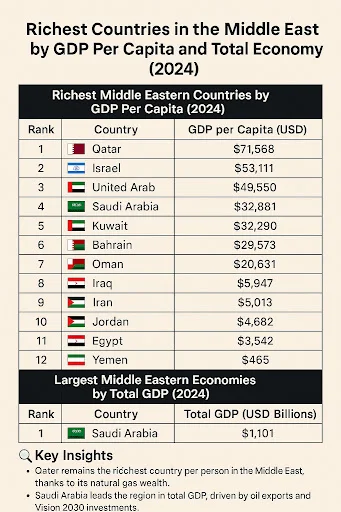
Richest Countries in the Middle East by GDP Per Capita and Total Economy (2024)

The Middle East is home to some of the wealthiest nations in the world. In this article, we compare countries by two key economic metrics: GDP per capita and total GDP. These rankings help identify the richest countries in the region in 2024.

🏆 GDP Per Capita: Highest Earning Countries in the Middle East (2024)

Rank Country GDP per Capita (USD)
1🇶🇦 Qatar$71,568
2🇮🇱 Israel$53,111
3🇦🇪 United Arab Emirates$49,550
4🇸🇦 Saudi Arabia$32,881
5🇰🇼 Kuwait$32,290
6🇧🇭 Bahrain$29,573
7🇴🇲 Oman$20,631
8🇮🇶 Iraq$5,947
9🇮🇷 Iran$5,013
10🇯🇴 Jordan$4,682
11🇪🇬 Egypt$3,542
12🇾🇪 Yemen$465

Source: Visual Capitalist

💰 Total GDP: Largest Middle Eastern Economies by Size (2024)

Rank Country Total GDP (USD Billions)
1🇹🇷 Turkey$1,344
2🇸🇦 Saudi Arabia$1,101
3🇦🇪 United Arab Emirates$536.8
4🇮🇱 Israel$530.1
5🇮🇷 Iran$469.1
6🇪🇬 Egypt$469.1
7🇶🇦 Qatar$235.5
8🇰🇼 Kuwait$183.6
9🇮🇶 Iraq$108.9
10🇴🇲 Oman$108.9

Source: Wikipedia

🔍 Key Economic Insights for 2024

  • Qatar remains the richest country per person in the Middle East, thanks to its natural gas wealth.
  • Saudi Arabia leads the region in total GDP, driven by oil exports and Vision 2030 investments.
  • UAE combines oil, tourism, and finance for a balanced economic power.

Conclusion

From oil-rich Gulf states to tech-driven economies like Israel, the Middle East shows economic diversity in 2024. Understanding GDP per capita and total GDP helps compare national wealth and development in the region.

Permitted Blood Alcohol Level


General Overview of Blood Alcohol Concentration (BAC)

BAC measures the amount of alcohol in your blood and is typically expressed as a percentage. 

For instance, a BAC of 0.05% means that there is 0.05 grams of alcohol in every 100 milliliters of blood. 

Different countries set legal limits for BAC levels to determine impaired driving.

Permitted BAC Levels by Country

The legal BAC limits for driving vary around the world. 

Below are some examples:

United States

Standard BAC Limit: 0.08% for regular drivers.

Lower limits (0.04%) for commercial drivers, and often zero tolerance (0.00%-0.02%) for drivers under 21.

European Union

Most EU countries: 0.05% (e.g., France, Germany, Italy).

Stricter in some countries like Sweden: 0.02%.

Zero tolerance in some (e.g., Czech Republic, Hungary, Slovakia).

Australia

Standard BAC Limit: 0.05%.

0.00% for learners, probationary drivers, and commercial drivers.

Canada

Standard BAC Limit: 0.08%.

Provinces may have lower administrative penalties at 0.05%.

Japan

Standard BAC Limit: 0.03%.

United Arab Emirates (UAE)

Zero tolerance: 0.00%.

Advantages and Disadvantages of Legal BAC Limits

Advantages

Safety: Enforcing BAC limits reduces the risk of accidents, as alcohol impairs coordination, reaction time, and judgment.

Public Health: It encourages responsible drinking and reduces alcohol-related injuries and fatalities.

Consistency: Having clear legal standards ensures that drivers are aware of acceptable limits.

Disadvantages

Variability: BAC limits may not account for individual tolerance; some people may be impaired even below legal limits.

Cultural Differences: What’s acceptable in one country might be too lenient or strict in another due to drinking customs.

Enforcement Challenges: Especially in rural areas or countries with limited law enforcement resources.

Most Searchable Questions and Answers

What is the legal alcohol limit for driving in my country?

The answer depends on the country, but the most common limit globally is 0.05% BAC for private drivers.

How long does alcohol stay in your system?

On average, the body metabolizes one standard drink per hour, but this varies based on body weight, gender, and metabolism.

Can I drive after one drink?

It's not advisable. 

Even one drink can impair your ability to drive, and you might still be over the limit depending on your body’s response.

How can I quickly lower my BAC?

Time is the only effective way. Drinking water, eating food, or taking a nap may make you feel better but won’t reduce your BAC any faster.

What happens if you get caught over the limit?

Penalties vary by country but generally include fines, license suspension, and possibly imprisonment for high BAC levels or repeat offenses.

Suggestions and Tips

Know Your Limit: Understand how many drinks it takes to reach the legal BAC limit in your country and account for individual factors like weight, gender, and tolerance.

Use a Breathalyzer: Personal breathalyzers can help you measure your BAC before deciding to drive.

Plan Ahead: If you're going to drink, arrange alternative transportation (e.g., taxis, rideshares) or assign a designated driver.

Wait it Out: If you're unsure whether you’re under the limit, give it more time before driving. 

BAC decreases at about 0.015% per hour.

Zero Tolerance for Work: Avoid consuming alcohol if you're going to work, especially in industries like construction, healthcare, or driving, where safety is paramount.

Stay Informed: BAC limits and enforcement methods may change, so stay updated on the laws in your region, especially when traveling abroad.

Impact of BAC Levels on Driving and Job Performance

Driving

Impaired Judgment: Even at low BAC levels (0.02%-0.05%), drivers experience reduced concentration, slower reaction times, and difficulty multitasking. 

Higher BAC levels result in blurred vision, poor coordination, and impaired motor skills, significantly increasing the risk of accidents.

Legal Consequences: If caught driving above the legal BAC limit, the penalties often escalate based on the level of intoxication. 

These include:

Fines: Vary based on jurisdiction and level of BAC.

License Suspension: Some countries revoke or suspend driving privileges immediately after a high-BAC violation.

Imprisonment: Especially in severe cases (accidents, injuries, or fatalities) or repeat offenses.

Insurance Impact: A DUI (Driving Under the Influence) can increase car insurance rates significantly or lead to policy cancellation.

Social Stigma: DUI convictions may carry a social stigma, impacting personal relationships and future employment prospects, especially in jobs that require driving.

Job Performance

Lower Productivity: Even low-level alcohol consumption before or during work can reduce concentration, accuracy, and efficiency.

Safety Hazards: In industries such as construction, healthcare, transportation, or manufacturing, impaired performance can lead to accidents, injuries, or fatalities.

Zero-tolerance policies in such jobs are common due to the high-risk environment.

Increased Absenteeism: Workers with high alcohol consumption are more likely to call in sick or arrive late, affecting overall productivity.

Impact on Reputation: A DUI or other alcohol-related offense can tarnish an employee’s professional reputation, especially in industries that value reliability (e.g., finance, education).

Termination Risks: Some companies have strict policies regarding alcohol use. 

A DUI conviction or evidence of alcohol impairment on the job can lead to termination, particularly in jobs involving public safety or company vehicles.

Top FAQs About BAC and Alcohol at Work

What is a zero-tolerance policy for alcohol at work?

This policy means no alcohol is allowed in an employee’s system while on duty, especially in safety-sensitive jobs (e.g., drivers, healthcare workers).

Can I be fired for DUI outside of work?

In some industries, especially those requiring driving or security clearance, a DUI conviction can lead to job loss, even if it occurred outside of work hours.

How do employers test for alcohol use at work?

Employers may use breathalyzer tests, blood tests, or random testing policies, especially in industries like transportation, where alcohol use could endanger lives.

Is it legal to drink at a work event?

Many companies allow moderate drinking at official events, but employees should be mindful of company policies and their alcohol tolerance. 

Drinking too much can lead to inappropriate behavior, harming professional relationships.

Tips for Avoiding Alcohol-related Issues at Work

Adopt a Zero-tolerance Approach: Even if your company allows drinking at social events, it’s safer to avoid alcohol entirely in professional settings.

Monitor Intake at Work Events: If drinking is allowed, limit yourself to one or two drinks, and avoid anything that might impair your judgment or behavior.

Seek Support: If you feel that alcohol is affecting your work or personal life, many companies offer Employee Assistance Programs (EAPs) that provide counseling and resources for substance abuse issues.

Suggestions for Safer Drinking Habits

Pace Yourself: Space out alcoholic drinks with non-alcoholic ones to keep your BAC from rising too quickly. 

Eating food while drinking also slows alcohol absorption.

Designated Drivers: Before a social gathering involving alcohol, arrange for a designated driver or rideshare service.

Know When to Stop: It’s always better to stop drinking early if you're unsure of how much alcohol is in your system. 

Waiting an hour or more per drink helps ensure alcohol is metabolized before driving.

Use Alcohol-free Alternatives: Opt for non-alcoholic beer or mocktails when you're in social situations that typically involve drinking but still need to drive or focus on work later.

Long-term Health and Social Considerations

Health Risks: Regular alcohol consumption, even below the legal limit, can lead to liver disease, cardiovascular issues, and cognitive decline.

Relationship Strain: Overuse of alcohol can negatively affect personal relationships, leading to conflicts at home or with colleagues.

Legal Ramifications: While BAC limits for driving are widely enforced, certain professions, including pilots, doctors, and heavy machinery operators, face stricter scrutiny. 

Missteps can result in loss of professional licenses or certifications.

In conclusion, managing alcohol intake is crucial not only to avoid legal consequences and safety hazards but also to maintain long-term health and job security. 

Understanding the legal limits for BAC, both in driving and in work environments, helps individuals make informed choices and encourages a culture of responsibility.

By adhering to tips for safe drinking and being aware of one’s limits, individuals can enjoy alcohol in moderation without jeopardizing their safety, career, or health.

Etihad Madrid-Abu Dhabi-Delhi Route: 2022 vs 2026 Changes

Etihad Airways Madrid–Abu Dhabi–Delhi Route

What Changed Between 2022 and 2026

Flying Etihad Airways from Madrid to Abu Dhabi to Delhi is one of the most convenient ways to connect Spain with North India through the Gulf. But if you've flown this route before and again recently, you may have noticed something different in the sky. Having personally flown this exact Etihad Madrid–Abu Dhabi–Delhi route in both 2022 and 2026, the difference in the flight path is impossible to miss. The change isn't a coincidence — it's a direct result of the ongoing Israel–Iran–US conflict and the airspace restrictions that followed.

In this article, we break down exactly how the Etihad flight route from Madrid to Abu Dhabi and Abu Dhabi to Delhi has evolved, why airlines like Etihad, Emirates, and Qatar Airways had to redraw their flight paths, and what it means for passengers flying this Gulf-hub route today.

2026 Etihad Flight Route Madrid- Abu Dhabi- Delhi


The 2022 Etihad Route

Flying Over Iran and the Gulf

Back in 2022, the Etihad Madrid to Abu Dhabi sector followed a fairly direct great-circle path — crossing the Mediterranean, cutting across Turkey, and heading down through Iranian and Gulf airspace before descending into Abu Dhabi's Zayed International Airport. On the second leg, Abu Dhabi to Delhi, Etihad's A320/A321 or widebody aircraft typically flew a short, efficient corridor straight across the Arabian Sea and Pakistani or Iranian airspace into North India. At that time, Iranian, Iraqi and Gulf airspace were considered routine transit zones for European–Asian traffic, and Gulf carriers including Etihad, Emirates and Qatar Airways relied heavily on this corridor to keep flight times and fuel costs down.

2022 Etihad Flight Route Madrid- Abu Dhabi- Delhi

The 2026 Etihad Route

Rerouted Around a Closed Sky

Fast forward to 2026, and the flight map tells a completely different story. Following the collapse of earlier ceasefire arrangements between the United States and Iran, and repeated confrontations involving Israel, aviation regulators including the European Union Aviation Safety Agency (EASA) moved to prohibit civil flights from operating in the airspace of Iran, Iraq and Lebanon at any altitude. Reports from March 2026 confirm that key flight information regions — including Iran, Iraq, Israel, Qatar's neighbouring corridors, Kuwait, Bahrain and Syria — remained closed or heavily restricted for civil aviation, pushing Europe–Asia traffic onto longer northern and southern bypass routes.

For Etihad's Madrid–Abu Dhabi–Delhi service, this means the aircraft I flew in 2026 no longer cuts straight across Iranian skies. Instead, Etihad — like Emirates and Qatar Airways — now follows one of two detours:

  • The southern corridor: routing via Egypt, the Red Sea and Saudi Arabia before joining Gulf airspace into Abu Dhabi.
  • The northern corridor: tracking further via Turkey, the Caspian Sea, Azerbaijan and Turkmenistan to bypass Iranian and Iraqi skies entirely.

On the return leg from Abu Dhabi to Delhi, aircraft now stay further south over Saudi Arabia and Oman before crossing the Arabian Sea directly into Indian airspace, avoiding the more direct overland corridor that was routine in 2022.

Why the Etihad Flight Path Changed

The Israel–Iran–US Conflict

The core reason behind this shift is regional security. After US strikes on Iranian nuclear facilities and rising Israel–Iran hostilities, Etihad Airways formally suspended operations through Iranian-controlled airspace over the Strait of Hormuz and the Gulf of Oman, following a similar move by the US Federal Aviation Administration and in coordination with the UAE's General Civil Aviation Authority (GCAA). Emirates and Qatar Airways followed with comparable restrictions, and Etihad also suspended its Abu Dhabi–Tel Aviv flights entirely during periods of active conflict.

Airlines were told in no uncertain terms to stay out of the danger zone. EASA's conflict-zone bulletins through 2026 continued to instruct operators not to enter Iranian, Iraqi or Lebanese airspace at any flight level, treating it as an outright prohibition rather than a mere caution. That's why, even during quieter periods when Iranian airspace has technically reopened, many carriers — Etihad included — have chosen to keep flying the longer detours rather than risk a sudden re-closure mid-flight.

What This Means for Passengers Flying Madrid–Abu Dhabi–Delhi

If you're booking an Etihad Madrid to Delhi via Abu Dhabi ticket in 2026, here's what to expect compared with a pre-2022 or 2022-era booking:

  • Longer flight times: Detours around Iran, Iraq and Lebanon can add anywhere from 45 minutes to over an hour to long-haul sectors, depending on winds, aircraft type and which corridor (northern or southern) is used.
  • Higher fuel burn and operating cost: Airlines are absorbing extra fuel and crew costs, which has contributed to firmer fares on Gulf-hub itineraries.
  • More congestion around Abu Dhabi and Dubai: With multiple Gulf carriers funnelling traffic through the same narrow bypass corridors, both Etihad and Emirates have warned of knock-on delays at departure.
  • Occasional short-notice schedule changes: Because the situation remains fluid, Etihad has cautioned that further disruptions, reroutes or cancellations can occur with little warning, so it's worth checking your flight status closer to departure.

Etihad's Response

Adapting Without Cutting Capacity

Despite the disruption, Etihad Airways has continued operating its Madrid and Delhi services rather than suspending them outright, unlike some international carriers that paused Gulf routes altogether during peak tension periods. Etihad's leadership has stated that the airline maintains multiple contingency flight plans and coordinates closely with the GCAA to decide which corridor to use in real time, depending on how the conflict is unfolding on any given day. Zayed International Airport in Abu Dhabi has remained fully operational throughout, meaning the disruption passengers experience is about the route in the sky, not the airport on the ground.

Etihad Madrid–Abu Dhabi–Delhi: 2022 vs 2026 at a Glance

Aspect2022 Route2026 Route
Airspace usedDirect path over Turkey, Iran and Gulf statesDiverted via Egypt–Saudi Arabia (south) or Turkey–Caspian Sea (north)
Iran/Iraq overflightRoutine and permittedProhibited under EASA and GCAA guidance
Flight durationStandard scheduled timeUp to 45–90 minutes longer on affected sectors
Main driverNormal commercial routingIsrael–Iran–US conflict and airspace closures
Airport operationsUnaffectedZayed International (AUH) still fully operational

(Tip: on a phone, swipe the table sideways to see all columns.)

Watch the Journey

For a first-hand look at how the in-flight experience and visible flight path compared, here's the video recorded during the journey:

Final Thoughts

Comparing the Etihad Madrid–Abu Dhabi–Delhi flight route across 2022 and 2026 is a striking reminder of how quickly geopolitics can reshape everyday air travel. What was once a routine great-circle path over Iran and the Gulf has turned into a carefully managed detour around a closed sky, all because of the escalating Israel–Iran–US conflict. For now, travellers flying Etihad between Spain and India via Abu Dhabi should budget a little extra time, keep an eye on schedule updates, and appreciate that behind every on-time landing is an airline quietly redrawing its flight plan almost in real time.

Note: Regional airspace restrictions remain fluid and can change rapidly. Always check Etihad Airways' official channels (etihad.com) and your airport's live status before travelling.

How is Middle East conflict affecting international flights?


The ongoing conflict in the Middle East, particularly in Israel, Gaza, and Lebanon, has significantly impacted international flights.

Many airlines have suspended or rerouted flights to avoid affected airspaces. 

For instance, Qatar Airways, Emirates, and Flydubai have suspended flights to destinations such as Iran, Iraq, and Lebanon, with some flight services restricted or canceled until further notice.

Long-haul flights are also facing challenges, as airlines are rerouting to avoid conflict zones.

The European Union’s Aviation Safety Agency (EASA) has issued advisories recommending airlines avoid flying over certain Middle Eastern countries, including Israel and Lebanon, which has caused more disruptions. 

British Airways, Lufthansa, and Delta Air Lines are among those that have suspended flights to Tel Aviv, while other airlines like Transavia have canceled flights to Amman and Beirut until early 2025.

If you're planning to travel through the region, it's important to reconfirm your flights, as schedules are changing rapidly depending on the evolving situation.


Alternative Routes

Given the significant disruptions to flights across the Middle East, travelers should consider alternative routes and transportation options if they need to pass through or near the region.

Rerouted Flights: Some airlines continue to operate by rerouting flights around conflict zones. 

This option may increase travel time, but it could be a safer alternative if you need to travel to nearby regions like Turkey, Cyprus, or Egypt. 

Emirates and Qatar Airways are rerouting flights, though availability may be limited.

Alternate Airports: If your destination is affected, consider flying to less impacted airports in neighboring countries, such as those in Turkey (Istanbul), Cyprus, or the UAE (Dubai or Abu Dhabi), which can act as a hub for further travel by road or other means to your final destination.

Connecting via Europe or Asia: Travelers needing to bypass Middle Eastern airspace may also choose to fly via Europe (e.g., Athens, Rome, or Istanbul) or Asia (e.g., Singapore, Hong Kong) and then connect to destinations farther afield. Some airlines are adjusting routes to avoid the region entirely.

Non-Air Travel: If you're already in the region and air travel is unavailable or uncertain, overland travel may be an option. 

While not feasible for all destinations, bus or car routes from countries like Jordan, Cyprus (via ferry), or Egypt could provide alternatives.

Travel Insurance and Flexibility: When planning travel through or near conflict zones, ensure your insurance covers disruptions and cancellations. 

Opt for flexible booking options to accommodate last-minute changes.

For more specific guidance, checking directly with your airline and monitoring travel advisories is essential.

Nuclear Bomb Can Be Stopped After Launch or Drop

Nuclear Bomb Can Be Stopped After Launch or Drop

Stopping a nuclear bomb after it has been launched or dropped is extremely difficult, and no current technology guarantees full protection against a nuclear detonation. However, there are some modern technologies and strategies that aim to intercept, neutralize, or reduce the impact of a nuclear attack. Here’s a breakdown of what is theoretically and practically possible today:

🔒 Prevention and Deterrence (Most Effective)

  1. Mutually Assured Destruction (MAD)

    • This Cold War-era doctrine is still relevant. It means if one country launches a nuke, the other will respond with equal or greater force, ensuring mutual destruction.
    • It discourages the initial launch.
  2. Treaties and Diplomacy

    • Nuclear Non-Proliferation Treaty (NPT)
    • Strategic Arms Reduction Treaty (START)
    • Diplomacy and inspections by the IAEA (International Atomic Energy Agency)

🛡️ Missile Defense Systems

These systems attempt to detect, track, and intercept nuclear missiles before impact:

  1. THAAD (Terminal High Altitude Area Defense)

    • Intercepts short- to medium-range ballistic missiles.
    • Deployed in South Korea, UAE, and by the U.S.
  2. Aegis Ballistic Missile Defense (BMD)

    • Ship-based system capable of intercepting ballistic missiles mid-flight.
    • Uses Standard Missile (SM-3) interceptors.
  3. Ground-based Midcourse Defense (GMD)

    • Designed to destroy intercontinental ballistic missiles (ICBMs) in space before re-entry.
    • Currently deployed in the U.S.
  4. Iron Dome / David's Sling / Arrow (Israel)

    • Highly effective at intercepting short-range threats (Iron Dome) and ballistic missiles (Arrow).

🔴 Limitations: These systems can only defend specific regions, may be overwhelmed by multiple warheads, and are less effective against hypersonic weapons or stealth delivery methods.

💥 Can a Dropped Bomb Be Stopped Mid-Air?

If a bomb is dropped from a plane, as opposed to a missile, interception becomes even harder:

  1. Air Defense Systems (e.g., Patriot Missiles, S-400, or S-500)

    • Can shoot down aircraft before the bomb is released.
    • Once the bomb is falling freely, almost no system can intercept it before detonation due to:
      • Speed
      • Low altitude
      • Short reaction time
  2. Electronic Warfare?

    • In theory, one could attempt to jam or disable guidance systems if the bomb is smart-guided.
    • But atomic bombs don’t rely on electronics to detonate once triggered — they are built to go off no matter what.

🧪 Advanced Concepts (Not Yet Real-World Ready)

  1. Directed Energy Weapons (Lasers)

    • Research continues into using high-powered lasers to shoot down missiles mid-flight.
    • Not yet practical for intercepting falling nuclear bombs.
  2. Hypersonic Interceptors or Space-based Weapons

    • Still theoretical or in early testing.

☢️ Can We Neutralize a Nuclear Bomb After Launch?

No current technology can "disarm" a nuclear bomb after launch. Once the fission or fusion chain reaction is triggered, it is impossible to stop the explosion. Therefore:

Best defense = early detection + missile interception + hardened infrastructure + diplomacy.

🏗️ Civil Protection Measures

If all else fails, countries prepare through:

  • Underground bunkers
  • Radiation shelters
  • Civil defense drills
  • Early warning systems (e.g., satellites, radar)

✅ Final Answer

No, there is currently no foolproof technology to stop the effect of a nuclear bomb after it has been dropped or launched. The best hope lies in:

  • Early interception (before detonation),
  • Preventing launch (via diplomacy or deterrence),
  • And civil defense preparation.

Strait of Hormuz

Why the Strait of Hormuz Is Always Important  

Why the World Is Watching Now

The Strait of Hormuz has been one of the most strategic maritime chokepoints in the world for decades. But in 2025, its relevance has taken on renewed urgency, raising global concerns. If you’ve ever wondered why the Strait of Hormuz matters so much to the world economy, oil prices, and international politics, you're not alone. This article presents detailed its historic and modern-day importance, current tensions, and what alternatives exist for global trade routes.

Map of the Strait of Hormuz showing oil transit routes

What Is the Strait of Hormuz?

The Strait of Hormuz is a narrow waterway, just 21 miles wide at its narrowest point, located between the Persian Gulf and the Gulf of Oman. It separates Iran to the north from the United Arab Emirates and Oman to the south. Despite its small width, it plays an outsized role in international maritime logistics.

This narrow passage connects the massive oil fields of the Middle East to the rest of the world, making it a vital artery in the global energy system. It is often described as the "jugular vein of the global oil supply."

Why Is the Strait of Hormuz So Important?

  • Energy Transit Hub: Around 20% of the world’s oil passes through the Strait of Hormuz—more than 18 million barrels per day.
  • Global Shipping Route: It is one of the busiest shipping lanes in the world for oil, natural gas, and petroleum-based products.
  • Geopolitical Flashpoint: The Strait lies at the center of one of the most volatile regions on Earth, the Middle East.
  • Limited Alternatives: Few viable options exist for rerouting such a vast volume of oil if the Strait were blocked or attacked.

Due to these factors, the Strait of Hormuz has been a strategic chessboard for superpowers and regional players alike.

Strait of Hormuz in 2025

Why It’s Back in Global Headlines

Recently, the Strait of Hormuz has returned to the global spotlight. A combination of geopolitical instability, military posturing, and increased naval activity has escalated tensions. Here's why:

1. Rising Tensions Between Iran and Western Powers

Iran has historically threatened to block the Strait in response to Western sanctions. In 2025, ongoing disputes over nuclear policy and oil export controls have once again ignited fears of closure.

2. Attacks on Commercial Tankers

Several recent attacks on oil tankers passing through the Strait have sparked global alarm. Though responsibility has not been definitively proven, fingers have pointed toward Iranian-backed groups, adding further pressure to an already strained environment.

3. Increased Military Presence

Naval deployments from the United States, the UK, and regional Gulf states have turned the Strait into a heavily militarized zone. Military exercises, drone surveillance, and warship traffic have all increased.

4. Oil Price Volatility

Whenever the Strait is threatened, oil prices spike. This is because any disruption in this key route can impact global supply chains, from Asia to Europe to North America.


Economic and Energy Impact

Why the World Should Care

The global economy is still significantly reliant on fossil fuels. Countries like China, India, Japan, and even the European Union import large quantities of oil that pass through the Strait of Hormuz.

If this route were to be blocked or compromised for even a few days, the resulting shockwaves would be felt in:

  • Fuel Prices: Gasoline and diesel prices would surge worldwide.
  • Inflation: Rising energy costs would trigger inflationary pressures across economies.
  • Supply Chains: Delays in oil and gas shipments would disrupt manufacturing and transportation globally.

This is why insurance premiums for tankers operating in the region have also increased dramatically.

Are There Alternatives to the Strait of Hormuz?

Given the Strait’s critical nature, multiple nations and companies have looked for alternative routes to reduce dependency. Let’s look at the most feasible options:

1. The East-West Pipeline (Saudi Arabia)

Saudi Arabia built the East-West Pipeline (Petroline) to bypass the Strait entirely. It allows oil to be transported from the Eastern Province to the Red Sea port of Yanbu. However, its capacity is limited—roughly 5 million barrels per day, a fraction of what the Strait handles.

2. UAE's Fujairah Port

The United Arab Emirates developed a pipeline from Abu Dhabi to the port of Fujairah, located outside the Strait. It helps export oil without transiting the chokepoint but still doesn’t come close to replacing Hormuz in volume.

3. Potential Overland Routes Through Iraq or Turkey

Though theoretically viable, these alternatives are fraught with their own geopolitical risks and logistical challenges. Turmoil in Iraq and strained relations between Turkey and other nations make this a complicated option.

In short, there is no full substitute for the Strait of Hormuz, making it a constant point of strategic interest.

The Role of Technology and Diplomacy

Satellite monitoring, maritime drones, and real-time shipping data are now used to track tanker movements and potential threats in the Strait. Meanwhile, diplomatic efforts continue to stabilize the region. The United Nations, EU, and regional coalitions are all working behind the scenes to keep the Strait open and secure.

Environmental Risks

In the event of a naval confrontation or tanker destruction, the environmental consequences could be devastating. Oil spills in such a confined marine area would impact marine biodiversity, local fisheries, and even the Gulf's tourism industries.

Why It Matters to the Average Person

You might not live near the Middle East, but if you drive a car, use plastics, or rely on global supply chains, the Strait of Hormuz matters to you. Any disruption could mean higher gas prices, more expensive flights, or increased costs for everyday goods. In a globally connected world, a small waterway 3,000 miles away affects your local economy directly.

Conclusion

Strait of Hormuz Is Small But Mighty

As we move through 2025 and beyond, the Strait of Hormuz remains a critical geopolitical pressure point. Its control, safety, and stability are essential for global energy security and economic well-being. Despite efforts to create alternatives, no other route currently matches its scale and strategic placement.

Governments, corporations, and citizens alike should stay informed about what happens in this tiny waterway. Because, as history has shown us time and again, the Strait of Hormuz is where small moves make global waves.

Search:

  • Strait of Hormuz importance
  • global oil supply routes
  • Middle East shipping lane
  • Iran Strait threat
  • alternatives to Strait of Hormuz
  • energy chokepoints 2025
  • why Strait of Hormuz matters
  • Gulf tensions oil
  • oil prices Middle East
  • maritime trade security

If you're interested in tracking updates about this topic, consider bookmarking our website or following our latest geopolitical analysis at Latestfoto.com.

📌 Call to Action: Want to advertise your global policy, oil & gas, or defense-related brand? Click here to place your ad in this article or reach out for sponsored content opportunities.

50 Real Places Where You Can Get Free Beer

A List of 50 Real Places in the World Where You Can Get Free Beer 

Breweries, Festivals, Maps & Travel Tips

For many travelers, discovering local beer culture is one of the most enjoyable parts of visiting a new country. From historic European brewing traditions to modern craft beer scenes in North America and Asia, beer is deeply connected to local culture. But what if you could experience this culture and sometimes enjoy free beer at the same time?

Yes, it is possible. Around the world there are breweries, festivals, visitor centers, and promotional events where visitors can legally receive complimentary beer samples or tastings. While this usually means small tasting glasses rather than full pints, these experiences allow travelers to try different beers without paying for every drink.

This comprehensive guide explains how travelers can find free beer around the world. It includes real cities, breweries, beer festivals, and practical travel strategies. Whether you are planning a beer-focused trip or simply curious about local drinks during your travels, this guide will help you discover where free beer opportunities exist.

What “Free Beer” Really Means

Before exploring the list of locations, it is important to understand what “free beer” typically means in travel and tourism. In most countries, breweries cannot simply give unlimited beer away. However, they often offer free samples for promotional or educational purposes.

Here are the most common situations where visitors receive free beer:

  • Brewery tours: Many brewery tours end with a complimentary tasting.
  • Beer festivals: Some festivals provide promotional samples from breweries.
  • Grand openings: New breweries sometimes offer free tastings.
  • Brand marketing events: Beer companies introduce new products with free samples.
  • Cultural festivals: Local celebrations may include brewery promotions.

In most cases the free beer is a small tasting glass, designed to allow visitors to explore new flavors while learning about brewing traditions.

50 Places With Free Beer Opportunities Around the World

The following cities and breweries are known for offering complimentary beer tastings during tours, promotions, or events.

Europe

  • 1. Dublin, Ireland – Guinness Storehouse tasting experience
  • 2. Amsterdam, Netherlands – Heineken Experience brewery tour
  • 3. Plzeň, Czech Republic – Pilsner Urquell Brewery tour
  • 4. Munich, Germany – Oktoberfest promotional brewery stands
  • 5. Bamberg, Germany – Schlenkerla Brewery visitor tastings
  • 6. Brussels, Belgium – Belgian Beer Weekend at Grand Place
  • 7. Bruges, Belgium – De Halve Maan Brewery tour tasting
  • 8. Prague, Czech Republic – Czech Beer Festival promotions
  • 9. Vienna, Austria – Vienna Craft Beer Festival
  • 10. Barcelona, Spain – Barcelona Beer Festival
  • 11. Madrid, Spain – Madrid Beer Week events
  • 12. Lisbon, Portugal – Lisbon Beer Week promotions
  • 13. Paris, France – Paris Beer Festival
  • 14. Copenhagen, Denmark – Copenhagen Beer Celebration
  • 15. Stockholm, Sweden – Stockholm Beer Festival
  • 16. Helsinki, Finland – Helsinki Beer Festival
  • 17. Tallinn, Estonia – Tallinn Craft Beer Weekend
  • 18. Riga, Latvia – Riga Beer Festival
  • 19. Vilnius, Lithuania – Vilnius Beer Festival
  • 20. Wrocław, Poland – Festival of Good Beer

North America

  • 21. Portland, Oregon, USA – craft brewery tasting events
  • 22. Denver, Colorado, USA – Great American Beer Festival week
  • 23. San Diego, California, USA – San Diego Beer Week
  • 24. Austin, Texas, USA – Texas Craft Brewers Festival
  • 25. Chicago, Illinois, USA – Chicago Beer Festival
  • 26. St. Louis, Missouri, USA – Budweiser Brewery Experience
  • 27. Asheville, North Carolina, USA – brewery tasting tours
  • 28. Boulder, Colorado, USA – craft brewery open houses
  • 29. Vancouver, Canada – Vancouver Craft Beer Week
  • 30. Toronto, Canada – Toronto Festival of Beer promotions

Asia & Oceania

  • 31. Tokyo, Japan – Tokyo Craft Beer Festival
  • 32. Osaka, Japan – Asahi Brewery Tour
  • 33. Bangkok, Thailand – craft brewery tasting events
  • 34. Singapore – craft beer week promotions
  • 35. Seoul, South Korea – Seoul Beer Week
  • 36. Melbourne, Australia – Good Beer Week
  • 37. Sydney, Australia – Sydney Craft Beer Week
  • 38. Auckland, New Zealand – Auckland Beer Festival

Latin America

  • 39. Mexico City, Mexico – Cerveza México Festival
  • 40. Guadalajara, Mexico – craft brewery tastings
  • 41. São Paulo, Brazil – São Paulo Beer Week
  • 42. Rio de Janeiro, Brazil – Mondial de la Bière
  • 43. Buenos Aires, Argentina – Buenos Aires Beer Festival

Africa

  • 44. Cape Town, South Africa – Cape Town Festival of Beer
  • 45. Johannesburg, South Africa – Jozi Craft Beer Fest
  • 46. Nairobi, Kenya – Nairobi Beer Festival
  • 47. Casablanca, Morocco – craft beer promotional events

Middle East

  • 48. Dubai, UAE – international beer events at hotels
  • 49. Tel Aviv, Israel – Tel Aviv Beer Festival
  • 50. Beirut, Lebanon – Beirut Beer Festival

Top Breweries That Give Free Tastings

Many large breweries operate visitor centers where tourists can learn about beer production and receive complimentary tastings.

  • Guinness Storehouse – Dublin, Ireland
  • Pilsner Urquell Brewery – Plzeň, Czech Republic
  • Budweiser Brewery Experience – St. Louis, USA
  • Asahi Brewery Tour – Osaka, Japan
  • Heineken Experience – Amsterdam, Netherlands
  • Carlsberg Brewery Visitor Centre – Copenhagen, Denmark
  • Samuel Adams Brewery – Boston, USA
  • Stone Brewing – San Diego, USA
  • Lagunitas Brewing Company – California, USA
  • Full Sail Brewing – Oregon, USA

These breweries are among the most popular tourist attractions for beer enthusiasts.

Free Beer Festivals Around the World

Beer festivals are one of the easiest ways for travelers to discover free beer samples. During these events breweries promote their products and often provide tasting opportunities.

  • Great American Beer Festival – Denver
  • Belgian Beer Weekend – Brussels
  • Copenhagen Beer Celebration – Copenhagen
  • Festival of Good Beer – Wrocław
  • Good Beer Week – Melbourne
  • Barcelona Beer Festival – Barcelona
  • Vancouver Craft Beer Week – Vancouver
  • Cape Town Festival of Beer – Cape Town

Countries Where Beer Is Extremely Cheap

Even if free beer is not available, some countries offer extremely affordable beer prices.

  • Czech Republic
  • Germany
  • Poland
  • Vietnam
  • Thailand
  • Mexico
  • Argentina

In many of these destinations, a local beer can cost less than a bottle of water.

How Travelers Find Free Beer

Experienced travelers often use several strategies to discover free beer opportunities.

  • Follow breweries on social media
  • Attend brewery opening events
  • Join brewery tours
  • Visit beer festivals
  • Check local tourism websites
  • Ask bartenders about tasting events

These strategies significantly increase the chances of discovering complimentary beer tastings while traveling.

Travel Story

Finding Free Beer Across Europe

Imagine traveling across Europe exploring historic beer cities. In Prague you visit a brewery museum and receive a tasting of traditional Czech lager. A few days later in Brussels you attend the Belgian Beer Weekend where dozens of breweries present their beers. In Munich you encounter Oktoberfest promotions where breweries celebrate centuries-old brewing traditions.

Each city offers a different experience, but the common theme is discovering beer culture while meeting other travelers and locals.

Map of Free Beer Locations

These locations span every continent. If you map the cities listed above, you will find clusters of beer destinations in:

  • Central Europe (Germany, Czech Republic, Belgium)
  • North America (USA and Canada)
  • Australia and New Zealand
  • Major Asian cities with craft beer culture

Planning a travel route through these destinations can create an unforgettable beer-focused trip.

FAQ About Free Beer

Is free beer legal?

Yes. Breweries can legally offer small tasting samples as part of tours, promotions, or festivals.

Which country has the most brewery tours?

Germany, Belgium, the United States, and the Czech Republic have the largest number of brewery tours.

Can tourists get free beer at festivals?

Some festivals include promotional tasting sessions where breweries provide small samples.

Do you need to be over 18?

Yes. Visitors must follow the legal drinking age of the country they are visiting.

Responsible Drinking

Beer culture is meant to be enjoyed responsibly. Travelers should always follow local alcohol laws, respect drinking age restrictions, and avoid excessive consumption.

Never drink and drive, and remember that tasting samples are meant for exploration rather than heavy drinking.

Conclusion

Free beer may sound too good to be true, but around the world there are many legitimate opportunities to enjoy complimentary tastings. Breweries, beer festivals, promotional events, and tourism experiences regularly introduce visitors to new beers through small free samples.

From Dublin and Amsterdam to Denver and Melbourne, beer lovers can explore dozens of destinations where brewing traditions are celebrated and shared with travelers. With the right planning and curiosity, discovering free beer can become an enjoyable part of your travel adventures.

Book & Save: Tiqets Kiwi GetYourGuide Amazon
Advertisement
AI Advisor — Ask me anything
Stays active all session
Hi! Ask me about travel, immigration, Spain, India, or any topic on Latestfoto.com. I find posts, affiliate deals, and follow-up questions for you.
Best places in Spain? Cheap flights Madrid US immigration 2026 India travel guide Free tours Europe
✨ Free AI Skin Analysis! Try Now →

✈️ Flight Deals

Error fares & cheap flights — updated daily

Loading flight deals…

Flight

facebook

Featured Post

XIV verbena Republicana Valladolid

The Verbena Republicana in Valladolid is a recurring music and community festival with a republican pol...

Last 30 days' visitors

AI Advisor
AI Advisor

Look what is published:

Try Desktop
Purchase from

chat

Ask a Question

Enhance Your Success with Increased Visitor Engagement!
Ready to leave your mark? Partner with us and witness your business flourish!

7 Days-Popular Articles


How to Find Articles Relevant to Your Interest.

Top Internet Search Topics.

Join Our Writing Community!

🚀✍️ Embrace your passion for words and turn your free time into an exciting writing adventure & earning! Collaborate with us and elevate your writing game. 🌟

🚀✍️ Explore the world of guest writing and enjoy the added bonus of a backlink to your blog. Let's create captivating content together! 🌟

Scan QR code. Buy me a coffee.

Enjoying This Website?

Give Us Your Vote!

Follow Us on Facebook

Follow Us on Facebook

Follow Us Now!

Buy & Sell Your Video

Have an interesting video? Earn money by sharing it with us.

Learn a Language for Travel, PR, or Citizenship

Offer Your Own Language
-------------------------
See More. Do More. Share More.
Join Our Newsletter

Get exclusive discounts & travel tips straight to your inbox.

Please type this word to confirm you're human:

© Latestfoto.com — Questions. Curiosity. Discoveries.