Showing posts with label ChatGPT. Show all posts

How AI-Generated Text Can Be Detected

Since ChatGPT's public release in late 2022, a parallel industry has grown around a single question: can software tell whether a piece of text was written by a human or a machine? Universities, publishers, and now blog platforms increasingly run submissions through "AI detectors" before accepting them. But how do these tools actually work, how accurate are they in 2026, and what do official research and publishing bodies say about relying on them? This article walks through the mechanics, the evidence, and the practical reality.

How AI detectors actually work

Most AI text detectors do not "recognize" a specific model the way a fingerprint scanner recognizes a finger. Instead, they analyze statistical patterns in language:

  • Perplexity — a measure of how predictable each word choice is, given everything before it. Large language models tend to choose highly probable next words, which produces low-perplexity, "smooth" text. Human writing is often less predictable.
  • Burstiness — the variation in sentence length and structure across a passage. Human writing tends to alternate between short and long sentences organically; AI output has historically been more uniform in pacing and rhythm.
  • Watermarking and model-side signals — some newer approaches rely on statistical watermarks embedded by the model provider itself, or on classifiers trained to recognize a specific model family's output patterns.

Detectors such as Turnitin's AI Writing Indicator, GPTZero, Originality.ai, Copyleaks, and Pangram build on these signals, usually combined with machine-learning classifiers trained on large datasets of known human and AI text.

How accurate are these tools, really?

This is where the picture gets complicated. Independent academic evaluations published through 2026 consistently find that detector accuracy is far from the near-perfect numbers vendors advertise.

A 2026 study in the International Journal for Educational Integrity comparing Originality and Turnitin found that Originality outperformed Turnitin on overall accuracy (0.69 vs. 0.61) and recall (0.60 vs. 0.51) — but both tools performed poorly on "hybrid" text, meaning writing that mixes human editing with AI-generated passages, which is increasingly how AI-assisted writing actually looks in practice.[2]

A separate 2026 systematic evaluation published on ScienceDirect concluded that current AI-generated-content (AIGC) detection tools "are not yet sufficiently robust or reliable for high-stakes academic decision-making," despite rapid improvements in the underlying detection algorithms.[3]

A peer-reviewed evaluation in a medical education journal (PMC) testing detectors and human reviewers side by side found that while detection tools could "meaningfully distinguish plausible AI-use conditions," reliability varied significantly between tools, and human scoring accuracy was uniformly low — reinforcing that people are generally worse at spotting AI text than the software is.[4]

The false-positive problem

Perhaps the most important finding for anyone publishing legitimate human-written content is the rate of false positives — human writing incorrectly flagged as AI-generated.

An earlier but widely cited 2023 evaluation by Weber-Wulff and colleagues, testing 14 detection systems, found that none of the tools reliably confirmed the accuracy claims made by their developers.[5] A related study published in Patterns found that a large majority of TOEFL essays written by non-native English speakers were incorrectly flagged as AI-generated by at least one of several detectors — because formal, careful, less idiomatic writing statistically resembles AI output, even when a human wrote every word.

This matters directly for blog and journal content: polished, well-structured, formal writing — exactly what most publications ask for — is the style most likely to trigger a false positive, regardless of who actually wrote it.

What official publishing bodies actually require

Detection tools are only half the story. The other half is policy — what journals, publishers, and editorial bodies actually require from authors. As of 2026 there is a stable, cross-industry consensus:

  • No AI tool can be listed as an author. The International Committee of Medical Journal Editors (ICMJE) states that AI tools cannot take responsibility for a work's accuracy or give final approval for publication — both required conditions for authorship — so they cannot be credited as authors, however much they contributed to drafting.[1]
  • Disclosure is required, not detection. The Committee on Publication Ethics (COPE) requires that authors using AI tools to draft text, generate images, or process data be transparent about it, typically in the methods or acknowledgements section, naming the tool and describing how it was used.[6]
  • Human authors remain fully accountable. Both ICMJE and the World Association of Medical Editors (WAME) are explicit that authors are responsible for the accuracy of anything an AI tool contributed, including checking for fabricated citations or incorrect claims — a well-documented failure mode of generative AI.[7]

In other words, the publishing world's actual safeguard against undisclosed AI use isn't a detector score — it's a disclosure requirement, backed by the much simpler fact that authors are liable for what they submit, detected or not.

Comparing the major detection tools

Tool Primary signal Reported strength Known limitation
Turnitin AI Writing Indicator Perplexity/burstiness classifier Widely deployed in higher education Independent accuracy estimates trail vendor claims; struggles with edited text
GPTZero Perplexity/burstiness classifier Fast, widely used browser-based check Sensitive to formal, non-native, or heavily edited writing
Originality.ai Classifier + paraphrase-resistance layer Outperformed Turnitin in 2026 academic testing Still weak on hybrid human/AI text
Copyleaks / Pangram Classifier + similarity/plagiarism check Combines AI detection with originality checking Accuracy varies by content genre and length

Practical takeaways for writers and bloggers

  1. Don't treat a detector score as proof of anything. Every major independent study through 2026 warns against using a single detector result as evidence, in either direction.
  2. Disclosure beats evasion. If you use an AI tool to help draft or organize content, a short, honest disclosure line is both the accepted best practice and far more defensible than hoping a detector never flags the piece.
  3. Editing matters more than tools realize. Heavily revised, fact-checked, human-edited AI-assisted drafts are exactly the "hybrid" text that current detectors handle worst — which cuts both ways: it can evade detection, but it can also mean genuine human work gets wrongly flagged.
  4. Accuracy and sourcing are the real risk, not detection. The bigger practical danger of AI-assisted writing is factual error or fabricated citations, not getting caught by a classifier. Verify everything an AI tool contributes before publishing it.

The bottom line

AI text detectors exist, they are improving, and some (like Originality.ai in recent testing) perform meaningfully better than others. But 2026 research is consistent on one point: none of them are reliable enough to serve as definitive proof that a piece of writing was or wasn't AI-generated, especially once a human has edited the draft. The publishing world has responded not by chasing better detectors, but by shifting the burden to disclosure and author accountability — a framework that works regardless of how good detection technology eventually becomes.

Sources

  1. International Committee of Medical Journal Editors (ICMJE). Recommendations for the Conduct, Reporting, Editing, and Publication of Scholarly Work in Medical Journals, Section V: Use of Artificial Intelligence in Publishing. icmje.org
  2. Hadra, M., Cambridge, K., Mesbah, M. (2026). Evaluating the accuracy and reliability of AI content detectors in academic contexts. International Journal for Educational Integrity, 22(4). link.springer.com
  3. Trusting AI to detect AI? A systematic evaluation of the reliability and robustness of current AIGC detection tools for student academic work (2026). ScienceDirect. sciencedirect.com
  4. Ability of AI detection tools and humans to accurately identify different forms of AI-generated written content. PMC. ncbi.nlm.nih.gov
  5. Weber-Wulff, D. et al. (2023). Testing of detection tools for AI-generated text. Summarized in: How Reliable Are AI Detectors For Academic Text? effortlessacademic.com
  6. Committee on Publication Ethics (COPE). Authorship and AI tools — COPE position statement (13 February 2023). publicationethics.org
  7. World Association of Medical Editors (WAME). Recommendations on Chatbots and Generative Artificial Intelligence in Relation to Scholarly Publication. wame.org

Beyond AI

Search engines have evolved dramatically over the years. Yesterday they relied mainly on keyword matching. Today, thanks to AI and large language models (LLMs) like ChatGPT, search is based on semantic understanding and context. But what comes after AI as we know it? Experts are already imagining possible futures that could redefine how humans interact with knowledge.

🔮 Possible Futures Beyond Today’s AI

1. Artificial General Intelligence (AGI)

Unlike today’s narrow AI, which specializes in specific tasks such as answering questions, AGI would have the ability to reason, learn, and adapt across every domain, much like a human—or even better. It could transform not only search engines but also problem-solving, decision-making, and creativity itself.

2. Neural-Computer Interfaces (Brain-to-Tech Search)

Imagine skipping the need to type or speak. With neural interfaces, a person could simply think of a question, and the answer would be delivered directly into their brain. Search would no longer feel external—it would be internalized knowledge.

3. Personal AI Agents (Persistent Digital Twins)

Future users may rely on personal AI agents that act as long-term digital companions. These agents would understand personal history, preferences, and goals—searching and learning on behalf of the user. More than assistants, they could become true thinking partners.

4. Knowledge Ecosystems (Decentralized Intelligence)

Instead of a single AI platform like Google or ChatGPT, intelligence could become decentralized. Think of a self-organizing, real-time verified network—like Wikipedia 10.0—but powered by millions of interconnected AIs.

5. Quantum AI

When quantum computing merges with AI, it could unlock answers to currently unsolvable problems. From medical breakthroughs to cryptography and massive simulations, Quantum AI may deliver solutions instantaneously.

6. Synthetic Reality & Mixed Reality Search

What if search became an immersive experience? Instead of reading about Ancient Rome, you could walk through a virtual reconstruction using AI-powered AR and VR. Search would transform into exploration, making knowledge something to be lived.

✨ In Summary

Yesterday → Search engines indexed text.

Today → AI interprets meaning and context.

Tomorrow → Knowledge may merge directly with human experience through AGI, neural interfaces, and immersive realities.

This rapid evolution shows that the future of search is not just about finding information, but about experiencing it in deeper, more personal ways.

Is it possible to know codes of any AI platform such as chatgpt

Accessing the code of an AI platform like ChatGPT is generally not possible unless the organization behind it decides to open-source it. 

OpenAI, the creator of ChatGPT, has released some models and research under open licenses, but not all their models are publicly available.

For example:

GPT-2: OpenAI initially released this model in stages due to concerns about misuse, but it is now fully available under an open license.

GPT-3 and later models: These models have not been open-sourced. 

Instead, they are accessible through APIs provided by OpenAI.

If you are interested in understanding or working with AI models, you can explore open-source alternatives and resources:

Hugging Face Transformers: A popular library with a wide range of pre-trained models, including versions of GPT-2 and other transformers.

OpenAI’s GitHub repositories: While the latest models may not be available, there are still many useful resources and older models.

Research Papers: Reading the research papers published by OpenAI and other organizations can provide detailed insights into how these models are developed and function.

For hands-on experience, you can:

Use the OpenAI API to interact with models like GPT-3.

Experiment with other large language models available in the Hugging Face Model Hub.

If you have a specific goal or project in mind, there may be other open-source tools and libraries that could be useful. 

Here are a few open-source AI tools and libraries that you can explore for various use cases:

Natural Language Processing (NLP)

Hugging Face Transformers:

Description: A comprehensive library that provides state-of-the-art pre-trained models for a variety of NLP tasks, such as text classification, named entity recognition, question answering, and text generation.

Key Features:

Supports numerous models like BERT, GPT-2, GPT-3, T5, and more.

Easy integration with TensorFlow and PyTorch.

Extensive documentation and tutorials.

Getting Started: pip install transformers

Link: Hugging Face Transformers

Documentation: Hugging Face Docs

spaCy:

Description: A popular library designed for production use, offering efficient processing of large volumes of text with a focus on performance and ease of use.

Key Features:

Pre-trained pipelines for various languages.

Integration with deep learning frameworks like TensorFlow, PyTorch, and Hugging Face.

Support for tokenization, part-of-speech tagging, dependency parsing, named entity recognition, and more.

Getting Started: pip install spacy

python -m spacy download en_core_web_sm

Link: spaCy

Documentation: spaCy Docs

nltk (Natural Language Toolkit):

Description: A comprehensive library for working with human language data, providing easy-to-use interfaces to over 50 corpora and lexical resources, such as WordNet.

Key Features:

Text processing libraries for classification, tokenization, stemming, tagging, parsing, and more.

Tools for working with structured data and unstructured data.

Getting Started: pip install nltk

Link: nltk

Documentation: NLTK Docs

Gensim

Description: A library for unsupervised topic modeling and natural language processing, using modern statistical machine learning.

Key Features:

Efficient implementations of algorithms like Word2Vec, Doc2Vec, and FastText.

Tools for topic modeling, document indexing, and similarity retrieval.

Getting Started: pip install gensim

Link: Gensim

Documentation: Gensim Docs

TextBlob

Description: A simple library for processing textual data. It provides a simple API for diving into common natural language processing tasks.

Key Features:

Easy-to-use interface for performing basic NLP tasks such as part-of-speech tagging, noun phrase extraction, sentiment analysis, classification, translation, and more.

Getting Started: pip install textblob

Link: TextBlob

Documentation: TextBlob Docs

AllenNLP

Description: A research library built on PyTorch for designing and evaluating deep learning models for NLP.

Key Features:

Pre-built models for a variety of NLP tasks.

Easy-to-use API for model configuration and experimentation.

Getting Started: pip install allennlp

Link: AllenNLP

Documentation: AllenNLP Doc

Tutorials and Courses

Natural Language Processing with Python: An excellent book that provides a practical introduction to programming for language processing.

Link: NLTK Book

Hugging Face Course: A free course that helps you learn how to use the Hugging Face Transformers library for various NLP tasks.

Link: Hugging Face Course

These tools and resources should give you a solid foundation for working on a wide range of NLP tasks, from basic text processing to building complex deep learning models for advanced applications.

Machine Learning and Deep Learning Frameworks

TensorFlow:

Description: An end-to-end open-source platform for machine learning developed by Google. It has a comprehensive, flexible ecosystem of tools, libraries, and community resources.

Link: TensorFlow

PyTorch:

Description: An open-source machine learning library based on the Torch library, primarily developed by Facebook's AI Research lab. It is widely used for deep learning applications.

Link: PyTorch

Keras:

Description: An open-source software library that provides a Python interface for artificial neural networks. Keras acts as an interface for the TensorFlow library.

Link: Keras

Data Processing and Visualization

Pandas:

Description: A fast, powerful, flexible, and easy-to-use open-source data analysis and data manipulation library built on top of the Python programming language.

Link: Pandas

NumPy:

Description: A fundamental package for scientific computing with Python, providing support for large multi-dimensional arrays and matrices, along with a large collection of high-level mathematical functions.

Link: NumPy

Matplotlib:

Description: A comprehensive library for creating static, animated, and interactive visualizations in Python.

Link: Matplotlib

Computer Vision

OpenCV:

Description: An open-source computer vision and machine learning software library. OpenCV was built to provide a common infrastructure for computer vision applications.

Link: OpenCV

Detectron2:

Description: Facebook AI Research's next-generation library that provides state-of-the-art detection and segmentation algorithms.

Link: Detectron2

Reinforcement Learning

OpenAI Gym:

Description: A toolkit for developing and comparing reinforcement learning algorithms. It supports teaching agents everything from walking to playing games.

Link: OpenAI Gym

Stable Baselines3:

Description: A set of reliable implementations of reinforcement learning algorithms in PyTorch.

Link: Stable Baselines3

These libraries and tools cover a wide range of applications and can serve as a great starting point for your projects in AI and machine learning.

Self-publishing

Self-Publishing: A Comprehensive Guide and Analysis of AI-Generated Content

What is Self-Publishing and How Does It Work?

Self-publishing refers to the process where authors independently publish their work without the involvement of traditional publishing houses. 

With the advent of AI technologies like ChatGPT, authors now have powerful tools at their disposal to expedite the writing process.

Why does ChatGPT not open in Mozilla


As for ChatGPT not opening in Mozilla, it could be due to various reasons such as browser compatibility issues, browser settings, or network connectivity problems. 

If you're experiencing difficulty accessing ChatGPT in Mozilla Firefox, you might try clearing your browser cache and cookies, ensuring that your browser is up to date, or using a different browser to see if the issue persists. 

Additionally, checking for any browser extensions or add-ons that might be interfering with the website could also be helpful.
If unable to see, then click on: https://youtu.be/jiGUa1YJZkU

Don´t believe blindly on Chatgpt

Nowadays, I am studying the French language in school, and I hope that I will be able to pass the exam to obtain a certificate at the A1 level of study. 

This is an initial level of study. 

I did not know anything about the French language except for "Oui," which means yes.

I go to a state-governed language school, and there are 15 students. 

How can ChatGPT support web developers to promote a website

Leveraging ChatGPT for Web Developers: A Comprehensive Guide to Boosting Website Promotion

In the competitive landscape of the digital era, web developers are constantly seeking innovative solutions to enhance website visibility and drive traffic. 

One such groundbreaking tool that has emerged is ChatGPT, a powerful language model developed by OpenAI. 

In this comprehensive guide, we will explore how web developers can leverage ChatGPT to promote a website effectively, covering various strategies and applications.

Content Creation and Optimization:

How ChatGPT Built Mobile App in Minutes


Unleashing the Power of Rapid Development: How ChatGPT Built a Mobile App in Minutes

In the dynamic world of technology, speed and efficiency are paramount when it comes to app development. 

Traditional methods often require extensive coding and testing, leading to prolonged timelines and increased costs. 

However, with the advent of advanced language models like ChatGPT, a revolutionary shift has occurred in the development landscape. 

In this article, we will explore the seamless process of building a mobile app in minutes using ChatGPT, while also delving into the various benefits and considerations.

Understanding ChatGPT:

¿ChatGPT puede predecir los números de la lotería de Navidad?


El uso de ChatGPT ofrece una ventaja notable, ya que puede proporcionar ideas valiosas y predicciones. Dirige a tu chatbot a examinar datos y tendencias pasadas para prever resultados futuros. Además, tienes la opción de buscar recomendaciones de números basadas en probabilidades estadísticas o análisis expertos. Gracias a ChatGPT, puedes personalizar tu enfoque generando números de la suerte personalizados o seleccionando dígitos basados en patrones o símbolos distintivos. Utiliza ChatGPT para idear una estrategia única que se alinee con tus preferencias e historial. Adopta la creatividad y experimenta con diversos enfoques para descubrir la estrategia más efectiva para ti.

ChatGPT can predict Lottery Numbers

Utilizing ChatGPT offers a notable benefit as it can furnish valuable insights and predictions. Direct your chatbot to examine past data and trends for forecasting future results. Additionally, you have the option to seek recommendations for numbers grounded in statistical likelihood or expert analysis. Thanks to ChatGPT, you can tailor your approach by generating personalized lucky numbers or selecting digits based on distinct patterns or symbols. Employ ChatGPT to devise a unique strategy aligning with your preferences and history. Embrace creativity and experiment with diverse approaches to discover the most effective strategy for you.

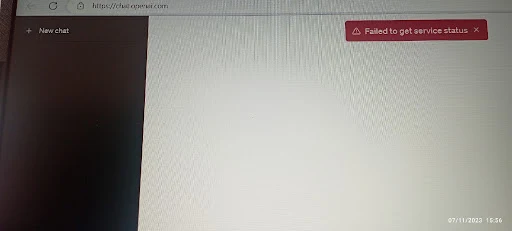
ChatGPT failed to get service status

The error message "ChatGPT failed to get service status" typically indicates a technical issue with the platform or interface you are using to interact with ChatGPT. It could be related to the service's ability to retrieve or display information about its own status or availability. If you encounter this message, it's possible that there could be a technical problem or a temporary disruption in the service.

Book & Save: Tiqets Kiwi GetYourGuide Amazon
Advertisement
AI Advisor — Ask me anything
Stays active all session
Hi! Ask me about travel, immigration, Spain, India, or any topic on Latestfoto.com. I find posts, affiliate deals, and follow-up questions for you.
Best places in Spain? Cheap flights Madrid US immigration 2026 India travel guide Free tours Europe
✨ Free AI Skin Analysis! Try Now →

✈️ Flight Deals

Error fares & cheap flights — updated daily

Loading flight deals…

Flight

facebook

Featured Post

flydubai

flydubai Why It Is in the News Today, Fares, Destinations and Owner flydubai is a Dubai-based airline that has suddenly become a top...

Last 30 days' visitors

AI Advisor
AI Advisor ❌

Look what is published:

Try Desktop
Purchase from

chat

Ask a Question

Enhance Your Success with Increased Visitor Engagement!
Ready to leave your mark? Partner with us and witness your business flourish!

7 Days-Popular Articles


How to Find Articles Relevant to Your Interest.

Top Internet Search Topics.

Join Our Writing Community!

🚀✍️ Embrace your passion for words and turn your free time into an exciting writing adventure & earning! Collaborate with us and elevate your writing game. 🌟

🚀✍️ Explore the world of guest writing and enjoy the added bonus of a backlink to your blog. Let's create captivating content together! 🌟

Scan QR code. Buy me a coffee.

Enjoying This Website?

Give Us Your Vote!

Follow Us on Facebook

Follow Us on Facebook

Follow Us Now!

Buy & Sell Your Video

Have an interesting video? Earn money by sharing it with us.

Learn a Language for Travel, PR, or Citizenship

Offer Your Own Language
-------------------------
See More. Do More. Share More.
Join Our Newsletter

Get exclusive discounts & travel tips straight to your inbox.

Please type this word to confirm you're human:

© Latestfoto.com — Questions. Curiosity. Discoveries.